

Whether you’re riding a rail trail, commuting through town, training on rural roads, or simply cruising through the neighborhood, one thing matters above almost everything else:
How cyclists behave shapes how cyclists are perceived.
Good cycling etiquette is not just about being polite. It’s about safety, predictability, accessibility, and preserving public support for cycling infrastructure. Every interaction — with other cyclists, pedestrians, motorists, equestrians, or trail users — becomes part of the public image of cycling as a whole.
Unfortunately, many conflicts involving cyclists are not caused by the bicycle itself, but by poor behavior, lack of awareness, or misunderstanding of shared spaces.
Add to this the fact that many municipalities and some states are placing restrictions on e-bikes and even standard bicycles. These restrictions are driven by two main factors. Many of these legislators still suffer from a pervasive misunderstanding of the standardized e-bike definitions and thus confuse e-bikes with e-motos (I’ve exhaustively explained the differences in previous articles and videos). Even more troubling though, is that enough cyclists are ignoring proper rules of cycling etiquette and thus driving cycling restrictions – and in the process, giving the entire cycling community a bad name.
But this article is not about blaming cyclists. It’s about helping riders understand how to ride responsibly, respectfully, and intelligently — because good etiquette protects both the cycling community and the future of cycling access.
What Cycling Etiquette Really Means
Cycling etiquette is a combination of:
- Courtesy
- Safety
- Predictability
- Awareness
- Respect for shared spaces
- Understanding laws and expectations
- Riding in a way that minimizes conflict
At its core, etiquette means recognizing that the spaces where we ride are not exclusive to cyclists. Proper cycling etiquette means exhibiting a clear understanding that trails are shared, roads are shared, and public spaces are shared. Nobody single group of users owns them outright.
Good cyclists understand that their rights come with responsibilities.
The Golden Rule: Be Predictable
The single most important thing a cyclist can do is to behave predictably.
Most conflicts and crashes happen because someone:
- Made a sudden move
- Failed to communicate
- Ignored surroundings
- Assumed others knew what they were doing
Predictable riding allows motorists to react safely, pedestrians to feel comfortable, other cyclists to avoid collisions, and trail users to trust each other.
Predictability is more important than speed, fitness, or skill.
The Rules of Cycling Etiquette
While many of the rules of cycling etiquette overlap based on the spaces where we ride, I’m going to break the rules down into several sections: general rules that apply across the board, some that are more specific to trail, road, or group cycling, as well as some specific for e-bicycles.
These are in no particular order.
General Rules
Rule 1: Stay to the Right
Obviously, this rule is for cyclists who ride in parts of the world that “drive on the right”, since we tend to use the right side of roads and trails for walking and cycling, as well as for driving.

Unless passing, cyclists need to remain on the right side of the trail. Adherence to this rule avoids such common problems as:
- Riding side-by-side and blocking traffic
- Drifting across center lines
- Taking corners wide
- Sudden direction changes
While the other problems listed above are straightforward enough, I want clarify that in certain circumstances, it’s not necessarily a problem for riding partners to ride side-by-side (“two abreast”) instead of single file. The problem arises when this is done consistently, at the expense of other trail users (including pedestrians) who pass or get passed by two-abreast cyclists who refuse to transition to single-file mode and ignorantly behave like they own the trail or road.
Cyclists, especially cyclists riding together (married couples, etc.) need to continually be aware of their surroundings, and change to single-file mode when someone is overtaking them or when pedestrians or other cyclists are approaching them from the opposite direction of the trail. It is completely unacceptable for two-abreast riders to refuse to transition to single-file mode when it matters.
Lane discipline always matters. Make it a habit.
Rule 2: Be Visible
Visibility is key to safe riding, whether on trails or public roads. Visibility includes the use of proper lighting and brightly colored clothing.
Even where not legally required during daylight, all cyclists should consistently employ front and rear lights, reflectors, brightly colored clothing, and reflective gear. Some helmets (such as the Lumos brand) have built-in lights.

When riding at night, proper lighting isn’t optional, it’s essential and is actually required in many states.
Clothing choices can range from brightly-colored cycling jerseys, high-visibility jackets or shirts, and the use of reflective material/stripes on clothing.
The point is that the more visible you are from a distance, the safer you make yourself and those around you.
Oh, and when it comes to front lighting, it’s a good idea to angle the light slightly downward, so that it’s not pointing directly into the eyes of other trail users. Just like we don’t appreciate motorists coming at us with their high beams on, aiming front bike lights high puts other trail users at greater risk because it can interfere with their ability to properly see the trail ahead.
Using proper lighting, clothing, and reflective surfaces increases visibility dramatically and can reduce the risk of injury.
Rule 3: Protect Your Head
Now, I know I’m going to get some knocks on the head (pardon the pun) about this, but helmet use is really important.
Not every state has made adult helmet use mandatory across the board. Some states have even made helmet use optional for motorcycle riders (which I personally think is myopic, stupid, and dangerous).
Because of this, a number of adult cyclists take the view that helmet use is optional on their bicycles.
But I’m a medical provider, and I can state categorically that head injuries can be very serious for anyone. For cyclists, they can be even more so, since we’re usually moving if we crash and strike our heads. And while people can still sustain head injuries even with a helmet on, they are generally less serious than those sustained when no helmet is used.
Beyond this point, many states have laws already requiring helmets for riders under 16 (or they’re in the process of creating such legislation). So, if we as adults don’t show our children that helmet use is important, how are they going to learn? Will they grow up to think – as sadly, some adults already do – that mandatory helmet use is just “government interference with my freedoms”? Or will they see their parents and other adults on trails and streets using helmets, and think that it’s just another essential piece of cycling kit? Children often mimic the behaviors they see, and I think we should lead by proper example.
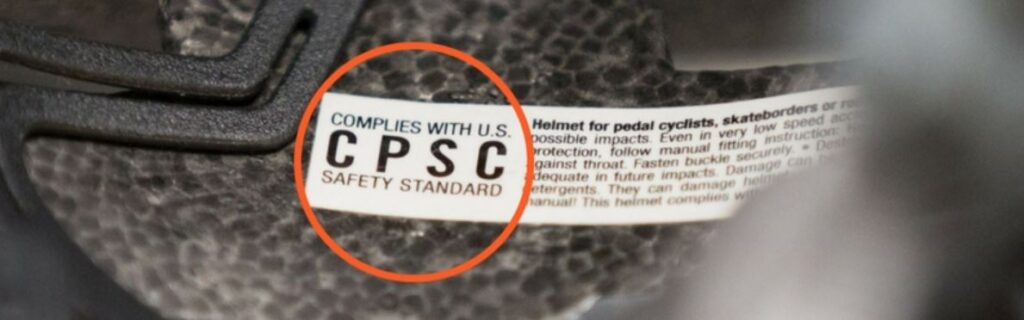
The Consumer Product Safety Commission (CPSC) has standards for bicycle helmets. When choosing a helmet for yourself, make sure that you see the “CPSC” sticker in the helmet somewhere. CPSC-certified helmets are required to carry such a sticker.
Motorcycle and e-moto riders require a U.S. Department of Transportation (DOT) certified helmet. Since motorcycles and e-moto vehicles are capable of much higher speeds than bicycles, they require a different level of protection.
It makes no difference what style, color, or brand of bicycle or e-moto/motorcycle helmet you choose, but the guideline is clear: just protect your head.
Oh, and while we’re talking about protection, let’s touch on body protection briefly as more of a guideline instead of a “rule.” If you’re a newer cyclist, it’s certainly not going to hurt to use elbow and knee pads for a while in addition to a helmet. If you do fall (hopefully never), joint pads afford greater protection. As you gain more experience and more confidence, you can likely forego the pads. Don’t think you’re going to look “weird”… especially for inexperienced riders, it’s better to protect yourself than to worry about how you’ll “look.”
Rule 4: Avoid Distractions and Maintain Situational Awareness
We’ve all heard about “distracted driving” and its risks. But distraction affects cyclists too.
Cyclists should avoid:
a) Looking at/interacting with phones while moving
I’m sure very few of us go cycling without our cell phones somewhere near us. There are also tons of different styles of cell phone holders that can be mounted on handlebars. But maintaining situational awareness and avoiding distractions involving our phones, means that we should set up our phones before we set out on our ride, and avoid interacting with the phone while moving. If you need to answer a call, text, or take care of other business on your phone while you’re riding, just stop and pull off to the side, take care of your business, and then get back on your way.
b) Riding inattentively in crowded environments
It’s also important to maintain your focus while cycling, particularly when you pass through crowded areas. Trailhead areas can commonly be more crowded, but at any given time, any part of a trail or a street in a town can be busier than normal. Festivals, street parties, and the like are common especially during summer months. Depending on the situation, it may be safer for yourself and others in the crowd to dismount and walk through the crowded area.
c) Wearing headphones that can interfere with awareness
If you’re like me, you like a bit of music while solo riding. You probably already know at least some of the various types of personal audio devices available to use. These include large over-the-ear headphones, in-ear headphones or “earbuds”, near-ear “bone conducting” headphones, and Bluetooth mono or stereo speakers.
Consider your surroundings. Those rechargeable Bluetooth speakers are not necessarily the best choice while riding because what you may like to listen to, may not appeal to others around you and can be distracting.
Likewise, over-the-ear headphones and earbuds make it much more difficult for you to hear your surroundings, even if the device you use has an “ambient” mode. And yes, I’ll get to pedestrians using these things a bit later.
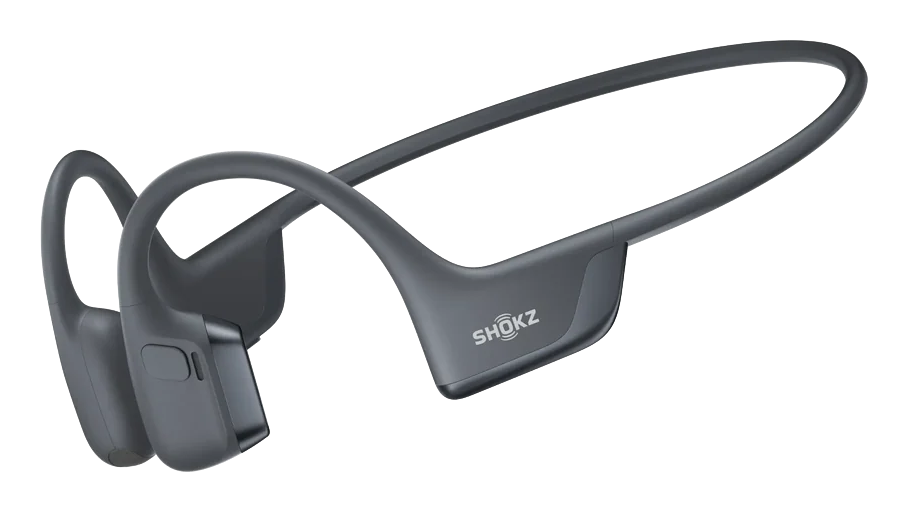
I’ve found that the “bone conducting” headphones like Shokz are the best choice while riding, because they loop over your ears and settle in front of your ears, not inside the ear canal. They are also relatively inexpensive and allow you to enjoy your favorite audio entertainment while also allowing you to fully hear sounds around you. This is important not only on trails, but more crucially on public roads.
Situational awareness is critical.
Rule 5: Control Your Speed
Trails and public roads are not race tracks.
Many trail systems are regularly used by families, elderly walkers, small children, dogs and other pets, casual riders, and people with mobility limitations.
Also, not all cyclists are at the same experience level. A speed that feels safe to an experienced rider may be terrifying to a new rider or a pedestrian.
On public roads, conditions can easily and quickly transition from safe to dangerous in a matter of seconds. Dedicated bike lanes can be blocked or simply just stop, road berms that aren’t officially designated as bike lanes can widen or narrow, and debris that could be dangerous to a cyclist can literally be anywhere along the sides of the road.
Cyclists need to adjust their riding speed based on the following:
a) Visibility: This point is much less about you being visible (since a different rule already covers that), than it is about the visibility of the trail or road. Sharp curves and hills present difficulties, and your speed needs to be adjusted to account for the potential risks that you can’t immediately see while riding. Riders or pedestrians may be coming “at you” on the other side of a blind curve. A disabled vehicle on the side of the road may be over that blind hill. Don’t assume that your pathway is always clear. Slow down around curves and hills.
b) Crowding & User Density: There’s no set rule that certain times of day or days of the week are the “least crowded” times to ride. Some trails, and some sections of longer trails, can frequently be more crowded than others. While road cyclists can anticipate that “rush hour” would be busy, other times of the day or specific road circumstances (such as accidents or construction) can quickly crowd up an otherwise lightly trafficked road. Adjusting speed based on the density of trail users and street vehicle traffic is essential for safe riding.
c) Surface conditions: Fully paved trails and crushed limestone trails feel different. It’s not too difficult to estimate your speed on a rougher surface. But because of the smoother ride on paved trails, it’s easy to underestimate how fast you’re going. A number of trails (like the Perkiomen Trail in the Philadelphia PA area) have a combination surface.
On the roads, the presence of potholes, debris, newly “tar-and-chipped” road surfaces, among other road surface issues, can cause problems for cyclists.
Even “Mother Nature” gets into the act. Weather conditions may cause water ponding or icing on certain portions of a trail or road surface.
Cyclists lessen the chance of injury to themselves or others, when they watch ahead for treadway/road surface changes and adjust their speed to compensate.
d) Trail width: Many multi-use trails are relatively wide, ranging from 8-14 feet of usable treadway width. However, not every trail has a consistent treadway width along its entirety. I’ve personally seen some trails where the width has gone from 8 feet to 3 feet, and back again. So, cyclists need to make allowances for changing trail widths. If you frequent a trail with such changing widths, you would likely remember where width changes are. But riding a trail for the first time is its own challenge, and good cycling etiquette includes cyclists looking ahead for narrowing trail segments and adjusting speed accordingly.
e) Weather: I haven’t met a cyclist yet who just loves riding on a stormy and windy day (my apologies if you’re a lover of bad riding weather). But I’m sure we’ve all been there… a bright sunny day, no wind to speak of, and you’re riding along when suddenly a cloudburst sneaks up on you and you’re scrambling for cover. Checking on weather conditions before setting out to ride can help minimize the risks of rapidly changing weather conditions during a ride that would cause you to have to ride very slowly, or even stop and seek cover under a bridge or a grove of trees.
Equally as concerning weather-wise, is the cyclist’s nemesis: headwinds. We’ve all probably thought that the “weather gods” are against us sometimes when it feels like you’re fighting a headwind both ways on an out-and-back. But such a phenomenon is much more due to your speed and the simple fact that you’re moving faster than a walking pace, than the weather itself. It is true, though, that sometimes weather conditions can be variable and winds can change direction from time to time. In these cases, the best thing we can do is to just “roll with it”, keep going, and stay safe. Adjust your body position, avoid pushing yourself too hard, and take as many breaks as you need.
f) Tunnels, bridges, and blind corners: Tunnels are usually cool to ride through (and sometimes much cooler inside than outside from a temperature perspective). Many bridges give us cyclists great views of rivers, streams, or gorges. But often, tunnels and bridges can have a narrower treadway width than the main trail. So, it’s important to go slower over bridges and through tunnels. Make sure your front lights are visible (particularly through tunnels), and anticipate that other trail users may stop for “selfies” on bridges.

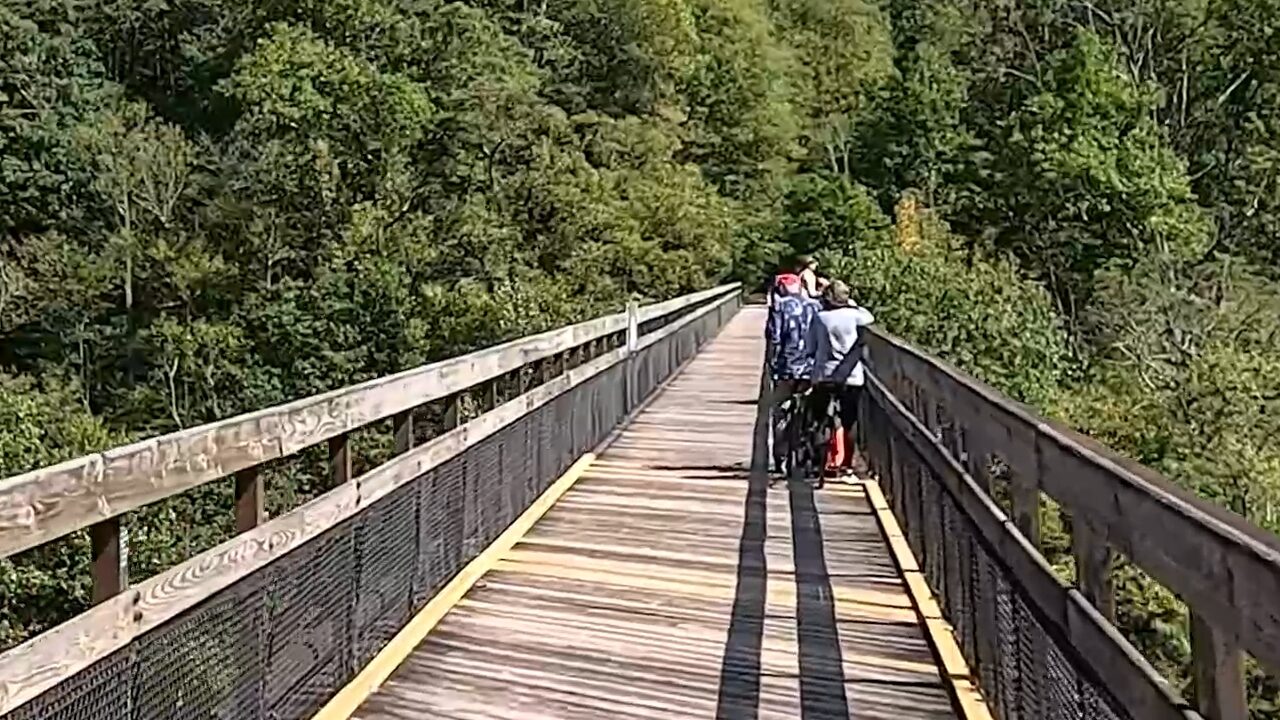
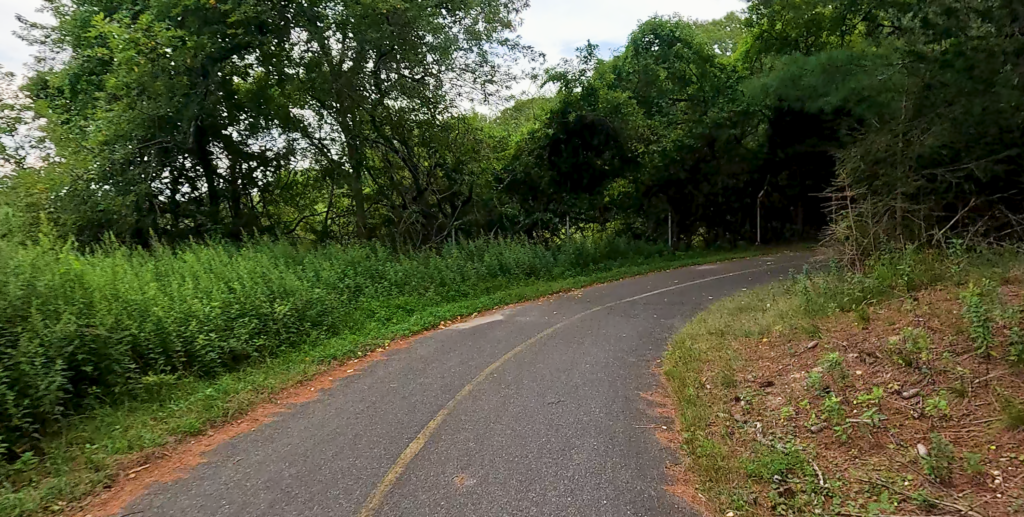
Blind corners also merit extra caution, demanding that the cyclist slow down when going around them because you have no idea what’s on the part of the curve that you can’t see. I read a comment from a Facebook user who said that he uses his bell when going around blind curves – and I think that’s a good idea.
Rule 6: Don’t Block the Way
This rule doesn’t just apply to group rides.
It’s unlikely that you’ll be riding and not stop along the way for any number of reasons, be it for a quick water break, or to pull out your phone and snap an incredible photo. But even though it may seem like you’re the only one around (and sometimes you may be), remember that trails and roads don’t belong just to you. You never know when someone will come along who wants to keep riding while you’re stopped.

So, when stopping:
- Move completely off the trail if possible
- Avoid blocking intersections
- Don’t stand in the middle of the path
Large groups, particularly family or friends riding together, should especially avoid creating bottlenecks. If one person wants or needs to stop, all the riders in the family or friends group should stop and pull to the side of the trail or road to avoid blocking others.
Leaving the trail or road lanes open for others when you stop, improves safety – both yours, and everyone else’s.
Rule 7: Pass Carefully, Not Aggressively
One of the biggest complaints about cyclists is unsafe passing. This is a concern not only on public streets, but also much more frequently on multi-use trails.
How many times have we seen complaints on social media, or while we’re on trails or quiet country roads, about some speed demon buzzing pedestrians with children or pets. I mentioned in my video and post on the (then upcoming) New Jersey e-bike law, that we’ll occasionally see the stereotypical “Lycra-clad youngster” racing down a trail, buzzing pedestrians and riders going more slowly than we are. I’m sure we’ve all encountered this type of cyclist on a road or multi-use trail at least once.
Now, I’m not going to begrudge this type of cyclist for the fact that they’re “getting out there” and getting exercise. But it’s the aggressive behavior that we sometimes see from them that is part of the problem. Such behavior feeds the perception that all cyclists behave exactly the same way.
We know that’s an inaccurate perception, but when a non-cyclist sees it just once, that incorrect perception only persists and festers.

So, it’s essential for cyclists to consistently practice proper passing etiquette:
a) Slow down before and while passing: A cyclist yelling “ON YOUR LEFT!” at high speed, just two feet behind someone is not only improper, it’s dangerous and invites accidents. Pedestrians – especially those in groups, or with children or pets – can act in unpredictable ways, and cyclists need to anticipate that.
Slowing down well before passing gives those whom you are intending to pass, more time to realize what’s happening and respond accordingly. This practice is also useful for giving deference to another cyclist or trail user coming from the opposite direction.
It’s not only proper to slow down well ahead of time, but also to go slowly while passing. Since anyone can act unpredictably, it’s best to go slowly to help minimize incidents.
b) Give audible warning: Some sort of audible warning with advance notice, is key to safe passing. Typical audible warnings include bells, buzzers or horns, or your voice loudly announcing your presence and intention to pass.
You’ve probably heard a variety of call-outs. The most common one in the U.S. is “ON YOUR LEFT!”. Others will say “passing” or “passing on your left”. If you watched any of my trail videos, you’ll know that I use the phrase “mind your left” which I’ve heard being frequently used in parts of Canada. If you’re about to pass someone who happens to be on the left side of the trail (which I’ve seen frequently), you could audibly warn, “passing behind you”, since “passing on your left” wouldn’t make sense in such a situation.
It really doesn’t matter what kind of warning you use, as long as it’s loud enough to be heard by people in front of you, and clear enough so that those whom you’re intending to pass understand what you’re trying to do and where you’re going to be passing them.
c) Pass with adequate space: Just like we expect cars to give us plenty of space when they pass us on a public road, the same concept applies to cyclists passing another cyclist or a pedestrian on a street or trail. Slowing down before passing helps here, because you have a better ability to maintain control and give the person you’re passing more space to react.
d) Be patient around children or dogs: I’ll expand on this point later, because it is its own rule.
e) Do not “buzz” pedestrians: I don’t care if those pedestrians are standing still and blocking the trail while talking with friends. Buzzing other trail users is not only incredibly rude, it’s stupid and dangerous. Don’t do it.
The goal is not simply to announce yourself — it is to pass safely and calmly.
Rule 8: Respect Pedestrians
Pedestrians are generally the most vulnerable trail users. Remember, trails aren’t exclusive to cyclists.
That means cyclists should:

a) Yield when appropriate: Remember when I mentioned about slowing down when other trail users are coming in the opposite direction? This is one example of where “yielding” is appropriate. While cyclists may be able to go faster around pedestrians, it’s important to yield way to pedestrians passing other pedestrians, especially when they’re passing on opposite sides of the trail. Let them go by, then clearly announce your presence and intention to pass the pedestrians on your side of the trail.
b) Slow down through crowded areas: There are a number of trails that pass through both rural, suburban, and urban areas. Frequently, such trails tend to be more crowded around large trailheads and access areas.
A perfect example of this is the Great Allegheny Passage that runs from Cumberland, MD, to Pittsburgh, PA. One of the most crowded areas of this 150-mile trail is around the Ohiopyle trailhead. The trail runs right through the very popular and frequently busy Ohiopyle State Park, where park visitors can walk from the trailhead area, across the “Ohiopyle Low Bridge”, and onward about a half mile to the “Ohiopyle High Bridge”. Both bridges offer breathtaking views of the rapids along the Youghiogheny River and are favorite spots for casual walkers and selfie-takers.
So, it’s important for cyclists to slow down around areas like this, and give deference to the walkers.
c) Avoid close passes: No one likes being “buzzed.” And just because we’re on bicycles and not in cars, doesn’t mean that we can do a practical “shoulder to shoulder” with trail users whom we’re passing. Slow down and give them plenty of space. If you can’t give them enough space because of treadway width or other treadway impediments (like bollards/trail barriers), or because of other trail users on the opposite side of the trail, be patient and wait your turn.
d) Exercise patience: You’ve no doubt heard of “road rage.” Well, yes, “trail rage” is also a thing.
You may be totally peeved that a family with small children is walking slowly along a trail while little Johnny is literally all over the trail with Mom & Dad not paying much attention.
And let’s not forget those pesky walkers with the big ol’ headphones covering their ears, seemingly oblivious to anything and anyone else around them. Sure, they should be using “Ambient mode” on their headphones (or not using those over-the-ear versions in the first place), but some of them seem to be in their own little world. You’ve probably been there – calling out or using your bell/buzzer, and they don’t seem to hear you at all until you’re almost on top of them. To compound the issue, when they finally do hear you, they step right into your path instead of staying where they are or moving further to the right. Grr.
But even if you think that a pedestrian is technically “wrong,” escalating the situation into “trail rage” never helps. Calm down… this too shall pass.
Courtesy prevents conflict.
Rule 9: Show Courtesy Toward Other Cyclists
Cyclists should show respect to each other.
It doesn’t matter whether you’re a recreational cyclist, a commuting cyclist, a road cyclist, a mountain biker, a rail-trail user, an e-bike rider, or an adaptive cyclist (trikes or other mobility assist cycles). We should all show respect for each other, because we’re all cyclists. Here’s another truism:
No single group “owns” cycling culture.
Showing courtesy towards other cyclists on roads and trails, includes:
a) Passing safely: We’ve already exhaustively defined this in Rule #7 and elsewhere.
b) Not drafting strangers without permission: “Drafting” is the practice of riding closely behind another cyclist to reduce wind resistance. Drafting can save energy and is common in organized group rides, but riding closely behind another cyclist requires trust and communication. Experienced riders rely on predictable behavior, and a stranger’s skill level is unknown. Avoid drafting strangers without permission from them, and always leave enough space to react safely if the person you’re drafting brakes, swerves, or hits debris unexpectedly.
c) Offering help to stranded riders: Experienced riders will tend to pack essential repair tools with them, such as a flat repair kit, an Allen key set, and a tire pump of some type. If you see someone on a road or trail looking like they have a problem with their bike, don’t just fly past them. Stop and ask if they’re OK or if they need help. A little courtesy goes a long way. You never know when you many need someone else’s assistance someday.
d) Respecting varying skill levels: Cycling is so very popular across all segments of our society – from children to the elderly, from extremely fit individuals to those with significant health conditions. This means that not everyone you encounter on a trail or road is going to have the same level of experience and confidence on a bicycle as you may. If you’re an inexperienced cyclist, don’t be discouraged by the few who seem to sneer at you for going more slowly than they are. And if you’re an experienced cyclist, show respect to those learning and gaining their confidence on a bicycle – don’t chide them or turn your nose up at them. No one likes snobs. Remember, you were new to cycling once.
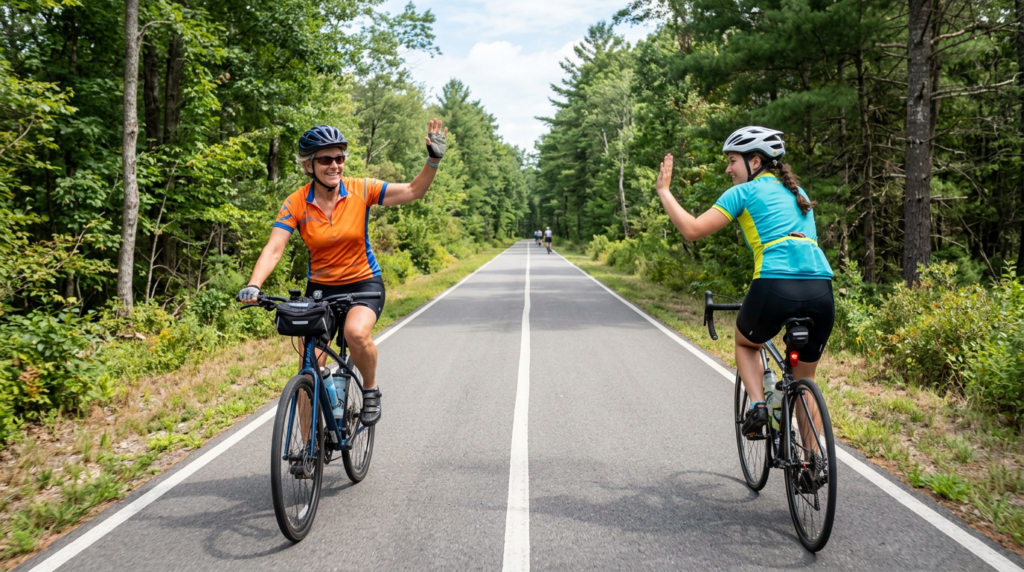
e) Acknowledging other cyclists: A wave of the hand, a cheery “good morning”, or even just a nod of the head shows respect for other cyclists that you encounter. It’s just common courtesy to acknowledge another member of the cycling community. When you pass someone, whether another cyclist or a pedestrian, wave your thanks, or verbally thank them for letting them pass you. Courtesy breeds good will.
f) Avoiding elitism: Oh, where do I start with this one? No doubt we’ve all encountered someone who exudes the “I’m better than you are” attitude.
It could be the stereotypical “Lycra-clad youngster” buzzing everyone on a trail because he’s pretending like he’s in training for the Tour de France. Or, it could be an alpha-female on a $6,000 Trek carbon fiber 27,000 speed bicycle (yes I’m being facetious), yelling at older folks on their e-bikes who are “in my way”, about how she thinks they’re “just lazy” for being on an e-bike.
Elitist attitudes among cyclists breed dismay, fear, resentment and anger. I’m going to say this once: if you think you’re better than other cyclists out there, get your head examined by a competent psychiatrist. As a medical provider, I can refer you to someone.
Since no single group of cyclists has the market cornered on cycling culture, none of us are any better or any worse than the other. It doesn’t matter what kind of bicycle or tricycle we’re riding. We are all cyclists, and our attitudes need to reflect that. Showing courtesy to other cyclists tangibly demonstrates that we acknowledge each others’ part in the overall culture of this great “thing” known as cycling.
Trail Etiquette
Multi-use trails are among the most valuable cycling resources in the country. Many pass through natural areas and green spaces that make a bike ride peaceful and enjoyable, not just a commute or an exercise routine.
They’re also spaces where cycling etiquette is extremely important, because so many different users share the same space.
Certainly the general rules apply when on trails, but here are a couple of rules of cycling etiquette that are mainly applicable to multi-use trails.
Rule 10: Leave No Trace
Cyclists should help protect the spaces around which they ride.
That means:
a) Don’t litter: If you wouldn’t throw a energy bar wrapper on your living room floor and leave it there, don’t do it on the trails where you ride. While some trail systems may have trash receptacles available, others may not. Throw your trash in public waste cans, or pack it out with you and throw it away at home.
b) Respect trail closures: Portions of a trail may occasionally need to be closed for public use due to flooding, landslides, or a number of other reasons. If you come upon a portion of a trail that’s blocked from use, don’t ignore the signs. Proceeding through portions that are marked as closed, risks injury to yourself and/or your bike. Trail managers (and I know a few personally) absolutely hate to have to block portions of their trails from use, and they work hard to fix the cause of the closure as soon as they are able. In other words, if a closure is in place, it’s there for a good reason. Don’t ignore them.

c) Stay on designated paths: On long and/or rural trails, as well as those that pass through state or national parks, you’re more likely to encounter paths that look like offshoots of the main trail. You may also see trail spurs that connect to a house, a housing plan, or a business. These “offshoots” of main trails are usually used for private access to the main trail, or for trail system service vehicles. Watch for signs designating if a particular “offshoot” is private use. Also, if one has a closed and locked gate across it, take that as a sign that it’s not for public use. Be respectful of private property, and don’t stray off of the main trail.
d) Respect wildlife and natural areas: As I said above, many trails that we can cycle on, run through rural areas and natural reserves. Always be on the lookout for wildlife. Don’t anticipate that what looks like a large twig isn’t really a snake across the trail. Squirrels, field mice, deer, and even bears may wander around and cut across a trail. Fields of wildflowers and other plant life thrive along many of our multi-use trails. So, be respectful of wildlife and natural places. Remember, the wildlife and plant life were most likely there long before the trail you’re on was created. So, we’re encroaching on their space, they’re not interfering with ours.
e) Be careful with trail conditions: While paved trails can occasionally be damaged, it’s more likely that the damage can be caused by natural forces rather than some angry cyclist taking a sledgehammer to a piece of pavement (when was the last time that happened?).
Natural surface trails, such as dirt, gravel, or crushed limestone, are much more susceptible to surface damage from cyclists and hikers proceeding on trails in very wet or muddy conditions. Check the condition of the trail surface before you ride. Do your best to avoid muddy or waterlogged areas. Not only will you be helping to minimize trail surface damage, you’ll be reducing your risk of injury from “wiping out” on an unstable surface.
Cyclists are often advocates for trail development and conservation. Our behavior should reflect that stewardship.
Rule 11: Be Extra Vigilant with Dogs and Children
Should I really have to say this?
Children and dogs are unpredictable. A dog on a long leash can suddenly cross the trail. A child may swerve unexpectedly, stop suddenly, or turn without looking. Even the best parents / pet parents can’t always stop a child or a pet from acting in an unpredictable manner.

This means that we cyclists have to be predictable, and anticipate these possibilities before they happen.
Follow the above-mentioned rules. Slow down. Call out. Give the parent time to reign in the dog or child. Be patient and expect to stop. Be courteous and audibly thank them when you pass.
When we look ahead, anticipate unpredictable behavior by those who whom we know can act suddenly and unpredictably, and when we behave courteously, we can avoid incidents and foster good will.
Road Etiquette
Cyclists have legal rights on roads in most states, but how cyclists conduct themselves strongly influences public attitudes.
I could probably go on for days, re-posting angry social media comments from motorists, let alone restrictive policy decisions from tons of local municipalities around the country, all that indicate how bad cycling behavior on public roads leads to anger, mistrust, and a desire to curtail cycling on public roads.
Again, these “road rules” are rooted in what I said earlier: when we as cyclists behave and lead by example, we foster good relations between the cycling community, motorists, and local governments.
Good road etiquette improves safety and reduces hostility.
So, here are a few rules of cycling etiquette more specific to public roads.
Rule 12: Follow Traffic Laws
Cyclists riding on public roads need to obey the same rules of the road that they would if they were driving cars or trucks.
This means that cyclists need to obey:
- Stop signs
- Traffic signals
- Lane markings
- Yield requirements
Even when cyclists are legally permitted to behave differently under certain laws, consistency and predictability remain important.

The Stupid “Idaho Stop”
I’m going to say here straight out that I personally don’t agree with the “Idaho Stop” concept that has been enacted in some states. If you’re not aware of what this is, the “Idaho Stop“ is a law that was first enacted in Idaho in 1982 that allows bicyclists to treat stop signs as yields, and red lights as stop signs. While I understand the principle behind such legislation, I don’t think that it should be considered universally, for two reasons.
First, certain circumstances (busy intersections are a perfect example) make the “Idaho Stop” concept unworkable or more dangerous. Secondly, engaging in “Idaho Stop” activity, particularly where it hasn’t actually been made state law, fosters envy or enmity of cyclists by non-cyclists, and leads to a perception that cyclists don’t have to follow the same rules of the road that motorists have to follow.
It can’t be understated that selective law-following by cyclists creates unpredictability and fuels resentment from motorists. It’s much better all around for cyclists on public roads to follow the standardized rules of the road.
Rule 13: Signal Your Intentions
Unlike motor vehicles, many (but not all) bicycles have built-in turn signals and brake lights. Some, like my Aventon Level.4, have these built in, but this isn’t universal. Many older standard and e-bikes have no such device capabilities built in, meaning that those cyclists have to either install third-party aftermarket signal devices (I have one for my Aventon Level.2), or use the long-standardized “hand signals.”
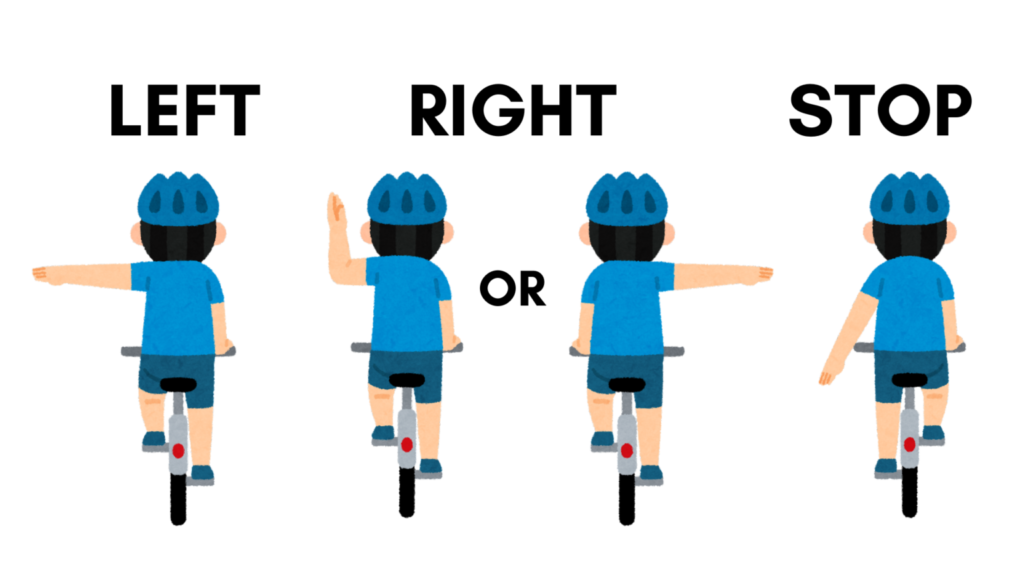
Cyclists using either hand or electronic/light signals help communicate:
- Turns
- Lane changes
- Stops
Granted, not every situation allows signaling safely, but communication matters, and cyclists need to incorporate some type of signaling methodology into their riding.
Rule 14: Ride Predictably in Traffic
Predictable behavior isn’t just for trails. It also needs to be followed on public roads.
Cyclists should avoid:
- Sudden swerving
- Weaving between parked cars
- Jumping back and forth between sidewalk and roadway
- Unpredictable lane positioning
Motorists can usually coexist with cyclists whom they can anticipate. Motorists don’t like cyclists being unpredictable.
Uncertainty creates danger.
Rule 15: Stay Off The Sidewalk
In towns and cities, sidewalks are primarily for walkers – hence the term sidewalk. They are meant for pedestrians and people with children or pets. In some municipalities, children on “kiddie bikes” are permitted on sidewalks since it’s safer for them than on road berms or bike lanes.
Granted, it’s not always possible for a cyclist to not use a bit of sidewalk. Take for a perfect example, the short stretch of the Allegheny River Valley Trail in Olean, NY, where the bike lane/berm disappears completely, and a cyclist practically has no choice but to use the 1/4 mile bit of sidewalk that runs along the Olean School District’s sports fields.
But these situations are rather few and far between. Just like many municipalities will allow very small children to ride on sidewalks, they tend to prohibit bicycles (and certainly e-motos) from public sidewalks.
Likewise, it’s not a good practice to keep jumping back and forth between the road and the sidewalk. This is behavior that both motorists and pedestrians can’t predict, increasing the risk of injury to the cyclist and others.
Be respectful, and when possible, leave the sidewalks to the walkers.
Rule 16: Don’t Escalate Road Rage
Just like “trail rage”, road rage is a very real danger for cyclists and other road users.
Just look on social media – there have been several incidents of road rage against cyclists reported just in the first few months of 2026 in various parts of the country, resulting in cyclist injuries and arrests of the motorist perpetrators.
So, properly responding to road rage is one of the hardest — and most important — rules of the road.
Cyclists may encounter:
- Aggressive drivers
- Honking
- Verbal harassment
- Unsafe passes or sudden braking
Responding with nasty gestures, yelling back, chasing, or striking vehicles, just makes situations worse and can considerably escalate danger to both cyclists and motorists.
Protecting your safety is more important than winning an argument. If safe to do so, it is better to pull off the road, stop, and let the offending motorist go by without making any response yourself. If necessary however, have your cell phone handy and call 911, leaving the line open so that any altercations can be recorded.
Group Ride Etiquette
Not every cyclist rides solo or with their partner or family. Group rides have become very popular in recent years, and as such, they require additional discipline, because poor behavior affects everyone in the group.
So, here are a few rules of etiquette that are more directed for group riders.
Rule 17: Don’t Block Entire Roads or Trails
Group riders need to avoid behavior that can lead to unsafe conditions and increase risk of injury. These include:
a) Riding excessively wide: Most group ride leaders will encourage a two-abreast riding approach during a group ride because it shortens the “train” or length of the group on a road or trail. Even when they don’t, it’s not only more respectful, but much safer, for group riders to ride no more than two abreast.
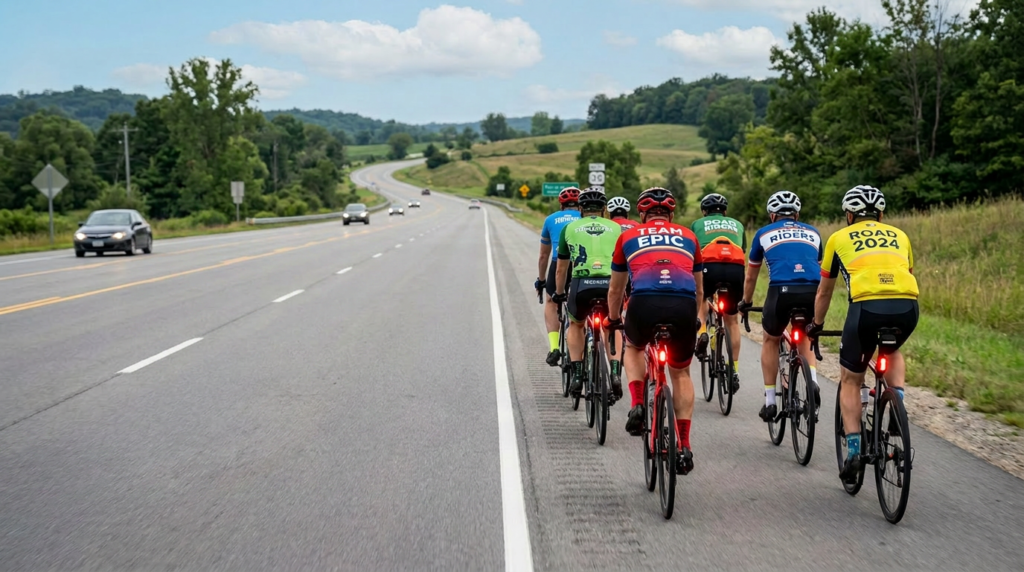
b) Blocking intersections: Many group rides will use trails with road crossings. I’ve seen the occasional large group ride where one cyclist will position him/herself in the middle of a road acting as a “traffic cop” while the group crosses the intersection, then will place him/herself at the back of the pack.
While this may not be problematic on rarely-used rural roads, this practice becomes more problematic on heavily-trafficked roads – especially if those roads don’t have crossing signals. The better option in such cases is for each cyclist in the group to cross when safe to do so, while the leads in the pack wait for the rest of the group at the other side of the crossing.
c) Preventing safe passing: Fortunately I haven’t seen this very often, but I have heard stories of angry solo cyclists attempting to pass a slow group ride on a long straight stretch of road or trail, and were effectively prevented from doing so. This is unacceptable behavior on the part of those in the group ride, and the ride leaders are responsible. Such behavior sets up dangerous situations for everyone – the group riders, solo riders, and pedestrians.
Even when technically legal, behavior that frustrates traffic only serves to harm public perception of cycling and cyclists.
Rule 18: Communicate Hazards
If you’re new to group riding, make sure that you know how the group ride leader and others in the group use call-outs to warn the group of hazards or other impediments to the ride experience. Experienced group riders usually know to call out things like potholes, loose gravel, slowing and stopping, pedestrians, and vehicles.
The ride leader will usually make the first call-out since he/she is at the head of the pack and will be the first to identify the hazard. But large groups require that such call-outs are communicated “down the line”, so be prepared to not only hear a call-out, but to pass it back to other riders behind you.
Proper communication can help prevent crashes and other dangers.
Rule 19: Match the Ride Style
Different rides have different expectations. A casual social ride such as the Philly Bike Ride (where streets are closed to vehicle traffic and cyclists can use the entire road), is a completely different situation from fitness or paceline rides where riders are expected to follow a pace and use a small portion of a road. Family rides also need to be managed differently.
Riders should understand the type of ride, its pace, and any special rules that they have, before joining a group ride.
E-Bike Etiquette
As e-bikes become more common, etiquette becomes even more important because public debate around e-bikes is often influenced by rider behavior.
Most conflicts attributed to e-bikes are actually conflicts involving:
- Excessive speed
- Reckless riding
- Inexperienced riders
- Poor trail awareness
While all of the rules of etiquette apply to e-cyclists as well as cyclists of non-power-assist bicycles, there are some etiquette rules for e-bikes that don’t often apply to standard bicycles.
Rule 20: No “Need For Speed”
Certainly this rule goes along with Rule #6, but where e-bikes are concerned, e-cyclists need to keep an even more vigilant eye on their speed, particularly with Class 2 e-bikes since they have throttle-assist options, and Class 3 e-bikes that can reach a maximum motor-assisted speed of 28 mph.
One of the biggest criticisms of e-bikes, which many non-e-cyclists misunderstand, is how fast they can actually go in real life circumstances. You may have heard of people complaining about e-bike speeds, under the mistaken assumption that standard bicycles can’t reach 20 or 28 mph. But that’s been proven incorrect time and time again. Some e-cyclists won’t reach their bicycle’s maximum motor-assisted speed because of additional weight on the bicycle such as packed panniers, extra batteries, etc. Besides, a great number of e-cyclists aren’t out for speed trials anyway. They just want to enjoy a bike ride at a leisurely pace.
Any excessive speed or higher rate of acceleration can startle pedestrians and pets. So, even though we e-cyclists can reach 20 mph (which helps when road cycling), it doesn’t mean we should maintain that speed consistently on trails.
Maverick is in Top Gun, not on a trail. On the ground we don’t need to shout “I feel the need, the need for speed!”
Rule 21: Respect Local Restrictions
Let’s get one thing straight. I decry the restrictions that some local municipalities and trail managers have placed on their trails that prohibit Class 2 or 3 e-bikes from their local trails. I contend that every single one of them are rooted in that old, disgusting misunderstanding of the e-bike class definitions and what they are capable of in real life.
But it doesn’t help that some e-cyclists, especially those riding Class 3 e-bikes, regularly max out their speed and violate other rules of cycling etiquette, which only serves to feed the misunderstanding.
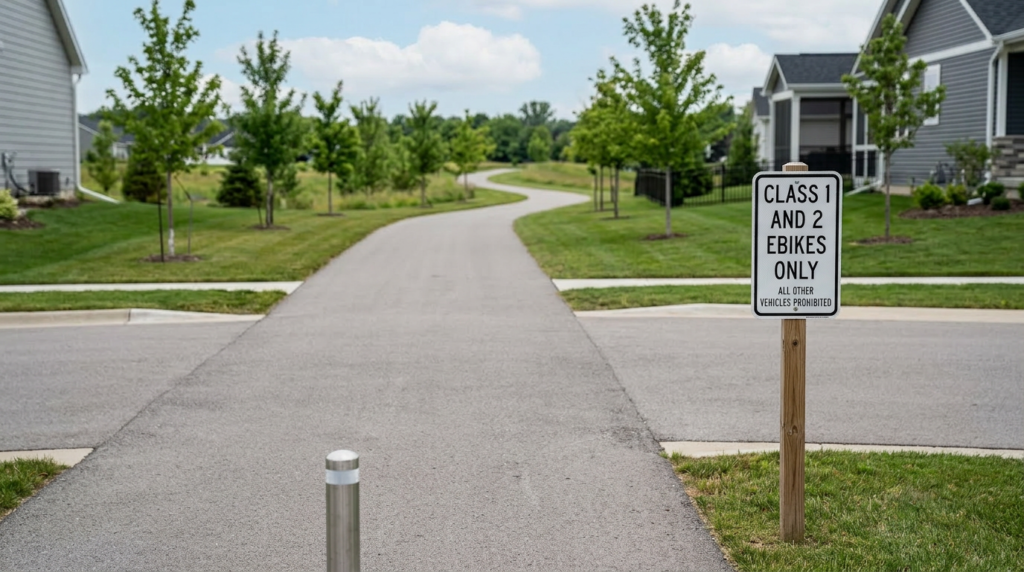
With that said, e-cyclists should check for restrictions before they ride. If a local municipality or trail has posted class restrictions, obey them, don’t ignore them. Good or bad, they’re in place for what the crafters of those restrictions think is a good reason, even if the reason is incorrect in actuality. When e-cyclists simply ignore such restrictions, even under the guise of “I’m not going to ride like a maniac”, they undermine any good will and e-bike advocacy efforts that we e-cyclists have been working very hard to build.
Ignoring local rules only serves to reinforce the “I was right” belief on the part of those who made the rules.
Courtesy matters more than motor assistance.
The Reality of Public Perception
Fair or unfair, the public often judges all cyclists based on the actions of a few.
One reckless rider can:
- Frighten pedestrians
- Anger motorists
- Create calls for restrictions
- Damage support for cycling infrastructure
On the other hand, courteous riders:
- Build goodwill
- Improve safety
- Encourage trail expansion
- Normalize cycling
- Strengthen advocacy efforts
Etiquette is not weakness. It is one of the strongest forms of advocacy that cyclists have.
The Benefits of Following The Rules
Cycling etiquette ultimately comes down to one simple principle:
Ride in a way that makes shared spaces safer, calmer, and more welcoming for everyone.
Good cyclists are not defined by their speed, their expensive equipment, their fitness level, or the total miles that they accumulate.
They are defined by their awareness, their patience, their responsibility, and their respect.
Every ride is an opportunity to either build support for cycling — or undermine it.
And in today’s environment, where cycling access and public perception are actively threatened, practicing proper cycling etiquette matters now more than ever.
Etiquette is not a personal choice or an option. It is essential. Good cycling etiquette is an essential part of cycling advocacy itself.


