

Welcome to Secrets of the Trails!
A Bit of History
I’ve always liked cycling. Years ago, I had a really cool 10-speed that I used everywhere, around town and on roads to nearby towns where I lived at the time. That was years ago, before “rail-trails” became a thing.
Several decades and a lot of “that’s life” later, I found that I had fallen out of practice with cycling. My old trusty 10-speed fell into disrepair, although I did keep up with a fair amount of walking in various park-based trails in my area during those years.
Back Into It
Following a major life-change (surviving 9/11) and a career change into medicine, that eventually allowed me to have more time on weekends to myself. So, with rail-trails by that time firmly established around my area and the country, I picked up an 18-speed mountain bike and headed out on the trails.
I loved having my weekend bike trail adventures, and was out a lot of weekends during the “season” in the northeast US. I loved seeing the nature, the towns, and the history all around the trails everywhere I went, both locally and trails a state or two away.
Unfortunately, a traumatic leg muscle injury, surgery and recovery caused me problems using my trusty 18-speed the way I used to pre-injury. Even after the typical recovery period was over, I had more difficulty with longer distances and positive grades on the trails. As a medical provider, I knew that this wasn’t just “you have to build yourself back up”, but represented a longer-term issue, and a standard bicycle wasn’t going to cut it anymore.
The E-Bike Revolution
So, I joined the electric bike revolution to do my surgical leg a favor. Ever since my first e-bike, I never looked back from this option for me.
Speaking as a medical provider, I recommend the use of standard bikes for anyone without significant leg injuries or arthritis issues with the ankles, knees, or hips. I would definitely recommend the electric bike option for those with any kind of lower extremity pathology or post-acute injury, in order to be able to still “get out there” without elevating the risk of further damage or injury.
The E-Bikes I’ve Known
As this is a “hi, how are you” post, I’m not going to get into the specifics of various e-bikes and their pros and cons. If you’re interested in learning more about e-bike technology and specifics, including test rides, etc., I’d strongly recommend that you visit your any full-service cycle shop in your area that carries e-bikes. These folks generally know their stuff inside out, and will not only help you choose an appropriate bike, but will very often service them as well. Your local bike shop is a great resource.
Schwinn
My first was a Schwinn Marshall e-bike. I liked this one and, when combined with an extra battery that I can “hot-swap” on the trails, I was able to extend my ride distances twofold without significant fatigue or injury. It was a nice bike and I was able to do some customization on it too, including a custom saddle, adjustable stem to rise and flare up the handlebars, and a rear pack rack.
However, I had some breakdown issues with the Marshall, specifically with the pedal sensor, then the bottom bracket, and finally the motor – all within the span of a year. I was “convinced” to do a trade-up while on a long bike trail on Long Island, New York and my Marshall just stopped pedal sensing and the motor was giving off kicking off and on. Fortunately for me (and my surgical leg) the trail was pretty much dead flat.
Aventon
I’m doing a HUGE shout out to Brands Cycle & Fitness in Wantagh NY! I consider them my “savior” in the bike realm because they put me onto a very reasonably priced Aventon Level.2 e-bike that very day when my Marshall effectively died. This saved the rest of my New York bike trail vacation that year!
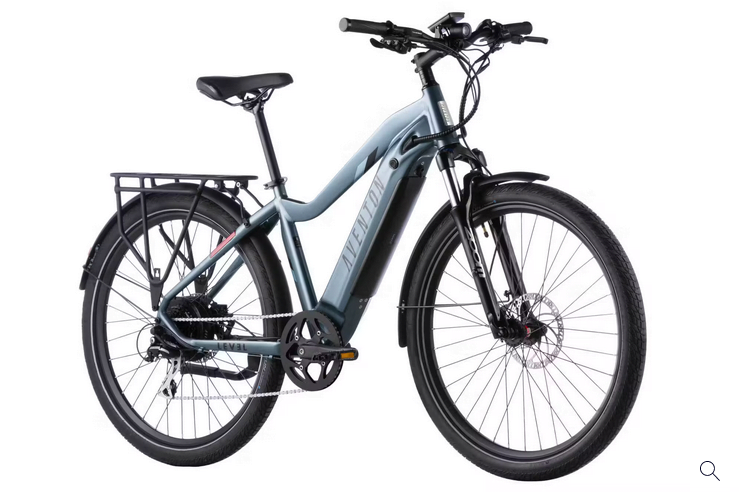
There are a couple of things that drew me to the Aventon Level.2. It’s the newer version of the original Level commuter e-bike and has a higher weight capacity than some others which is great for those who are in a higher weight class (aka obese), and those who do multi-day rides and have a lot of pannier packing. Even though Aventon classes this as a “commuter” e-bike, I’ve found it works equally well on road and trail.
Also, something that’s become pretty standard with Aventon, is “torque sensing”. This type of sensor offers a more natural feel of a standard bicycle by responding to and matching your efforts. Basically it allows battery life to be conserved and extends riding range; the harder you pedal, the more the torque sensor kicks in and amplifies your own efforts with the motor.
Trail Maps
Lots of people, me included, use cycling on trails for exercise, not just pleasure and relaxation. To that end, many use fitness apps and often trail map software.
My favorite apps for both iPhone and Android are AllTrails and TrailLink, the latter run by the Rails To Trails Conservancy. These apps offer you the ability to check out trails that you may want to try out, including segment distances, features mapping, trail conditions, and often have comments from other users about trail users with helpful advice before you try out a particular trail.
I favor the AllTrails app because of its ability to track my rides in real-time (you have to create an account for this feature). This helps me to save the rides I’ve done, and be able to offer recommendations to other app users about the various trails.
This brings me to the reason for this blog.
Planning and Riding
In all my rides so far, both local and distant, a few things have struck me about what I would like to know about the trails I’m riding or planning on riding.
History
There’s a decent amount of history on many of these trails. Some run through coal-mining regions. Others may pass along once-thriving communities that are now shells of their former selves. Still others run along railroad rights-of-way repurposed by communities and organizations who want a safe-space for families to walk, run, or bike. In other words, many of these trails have a story that can sometimes get overlooked.
Practical Matters
Using map programs or even a physical trail map offered by an organization, doesn’t always tell you everything you’d want to know about how to get to a trailhead, what parking looks like, how safe a parking location may be, etc. While you can certainly use Google Maps or similar mapping software to zoom in in satellite mode, to look at an intended parking spot or other location of interest, it’s not always as accurate as seeing the “lay of the land” on the ground – especially if you’ve never been to a particular trail before.
Long Trail Segments
Many of these trails have multiple trailheads, not just at the start and end points. The reason for this is obvious, especially with very long trails or multi-state trails, as multiple trailheads give people easier access. Additionally, if you’re a “segment rider” like me, you can more easily plan on completing a very long trail, by riding it in segments over time.
Secrets of the Trails
All of these matters have sparked a desire in me to do a bit of research into the history and practical issues around the trails that I’m riding. But why keep all of that to myself? It’s better to share!
With that in mind, I’m starting my series on “Secrets of the Trails.” Whether you’re a runner, walker/hiker, or cyclist, it’s my hope that you may gain some additional insight into the trails you frequent, or maybe be inspired to check out a trail that you may not have seen yet.
Here we go…


