

New Jersey Wants to License All E-Bikes?
What’s the difference between e-bikes vs e-motos? And which ones are more “dangerous”?
Recently, I’ve been informed about recent legislative efforts in New Jersey and various local jurisdictions around the country, that could have serious consequences for cyclists, trail users, and anyone who cares about active transportation.
Earlier this year (2025), New Jersey Senate President Nick Scutari put forward a bill that would require all electric bikes, regardless of power, speed, or design, to be licensed, registered, and insured, just like motorcycles.
You may have also read on various cycling groups on social media, that similar laws and regulations are being planned or are already implemented in other areas of the country.
But the New Jersey bills (S4834 and A6235) and a law recently enacted in Connecticut, are examples of STATEWIDE restrictions on e-bikes.
And while this might SOUND reasonable at first glance, the problem is this:
It completely misunderstands what an e-bike actually is.
What Is an E-Bike, Really?
Let’s clear up a very common misconception that some people, particularly some local and state legislators seem to suffer from.


An e-bike is still a bicycle. It is absolutely NOT a motorcycle.
Under the widely adopted three-class e-bike system, which New Jersey already recognizes, the classes and differences go like this.

Class One is pedal-assist only, with a maximum motor-assisted speed of 20 miles per hour. Class Two is a throttle-assist, again with a maximum motor-assisted speed of 20 miles per hour. Class Three is a pedal-assist, with a maximum motor-assisted speed of 28 miles per hour.
E-Bike Commonalities
While there are some differences among the classes of e-bikes in terms of whether one type has a throttle and one type doesn’t, the important point is what all three classes of e-bikes have in common:
- They all have fully operable pedals.
- They’re all human-powered first.
- They all use relatively small electric motors, no greater than 750 watts.
- The motor system is designed to assist pedaling, not replace it.
In fact, Federal law (Consumer Product Safety Act, 15 U.S.C. p 2085) defines e-bikes as “low speed electric bicycles” using the criteria that align with the well-established three-class system. The CPSC says that a vehicle that doesn’t meet all three requirements isn’t a low-power electric bicycle, it’s a motor vehicle.
E-bikes weigh roughly the same as a touring bike with panniers, move at speeds similar what a non-e-bike cyclist can achieve, and are already governed by existing traffic and trail rules.
E-Bikes Already Follow The Rules
In nearly every jurisdiction in the country, cyclists who are using public roads are expected to follow standard traffic rules that apply to motor vehicles, including:
- stopping at stop signs
- obeying traffic signals
- yielding to pedestrians and at posted intersections
- signaling their intentions to turn
- not exceeding posted speed limits

Even on many multi-use trails, speed limits for bicycles – standard and e-bike – are usually posted at 15 mph. Even when they’re not, it’s widely understood among cyclists that they should not exceed 15 mph.
While some e-bike manufacturers offer a software option for a Class 2 throttle-equipped e-bike to act like a Class 3 in terms of maximum motor-assisted speed, the point is that none of the e-bikes that conform to the three standard classes and thus the Consumer Product Safety Act, can go over 28 mph motor-assisted speed.
“Motor-Assisted” Is The Key Phrase With E-Bikes
The term “motor-assisted” is very important here.
“Motor-assisted” means that the electric motor assists the cyclist with locomotion. It’s not the same as a cyclist not doing anything but sitting there on the bicycle and letting the motor do all of the work – that’s what Class 2 e-bike throttles are for. However, practically everyone I know who owns a Class 2 throttle-equipped e-bike has been told at some point that using the throttle constantly and never pedaling isn’t healthy for the motor because it will burn it out in short order.
This is why throttles are mostly used for short-term assistance, not constant-use motion, and why pedaling is still required in order for the motor to actuate and assist the cyclist.
On e-bikes, the motor assists, it doesn’t do “all the work.”
My Personal Experience with Motor Assistance
I’ll give you a perfect example. My Aventon Level.2 is a 500W, Class 2 e-bike with a thumb-actuated throttle.

If you’ve watched any of the videos on the Secrets Of The Trails YouTube channel, you may have wondered how my voice can sound so smooth when I’m riding on seemingly rougher terrain. It’s because while I’m speaking on-camera, I’m doing it in short intervals (and splicing them together in post-production), and while speaking, I’m either using the throttle intermittently and not pedaling, or not pedaling forcefully, since pedaling can tend to make the voice sound choppy.
Now, the Level.2 has the capability to toggle a “Class 3” capability through the Aventon app.
While I don’t have it toggled on, because I don’t need it and it uses up more battery power, I did try it once on a long and desolate stretch of public road (that had a posted speed limit of 35 mph, by the way), to see what it does.
I can truthfully and clearly state from personal experience that when in “Class 3 Mode”, I still have to pedal to attain a 28 mph speed – the motor didn’t push the e-bike to 28 mph when using the throttle alone and not pedaling – using the throttle alone, the speed capped at 20 mph. Also, the motor absolutely cut out and stopped providing power once the sensor detected that the bicycle’s speed had achieved 28 mph… I know because I felt and heard it.
The Motor ASSISTS, It Doesn’t REPLACE – Even In Class 3
Even in Class 3 mode, using the throttle alone and not pedaling, only achieved a maximum speed of 20 mph. This is the same for all e-bikes that are built to the standard three-class system. E-bikes that are designed as Class 3 in the first place, can only achieve a maximum of 28 mph until the motor stops assisting the cyclist, only when the cyclist is actively pedaling. This is the very definition of “motor-assist”, and makes all legitimate e-bikes that adhere to the standard three-class system, legally not “motor vehicles”, but are in fact “low-powered electric bicycles” according to Federal law.
Who Uses E-Bikes?
Now, let’s face it… ANYONE on a bicycle, standard or e-bike, can very easily exceed 28 mph… if you’re going downhill and you’re peddling really, really hard. But that isn’t the norm.
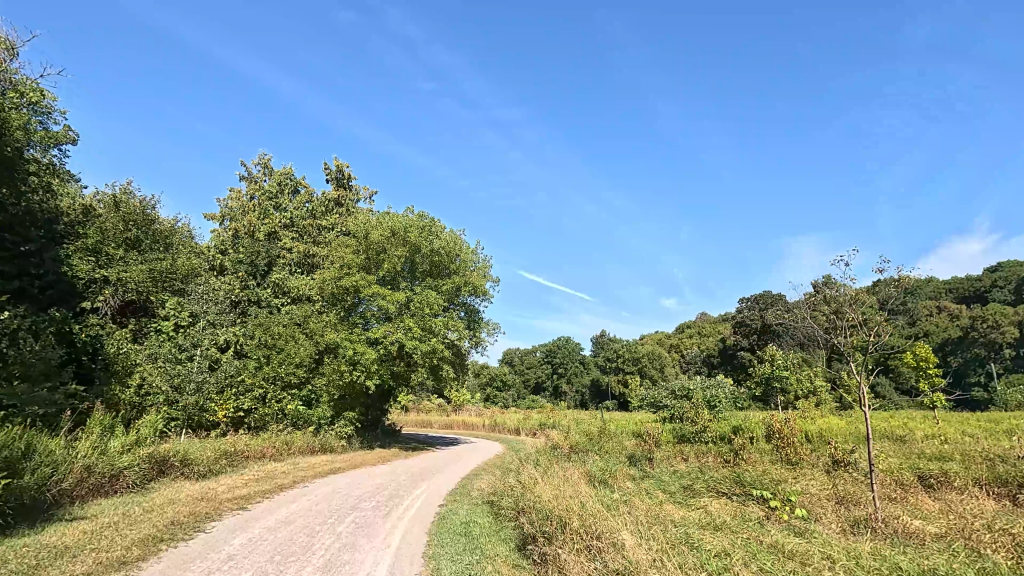


Most people who use e-bikes, or standard bicycles for that matter, use bicycles for exercise, for getting out into nature, relaxing (there’s a reason why I always say in my videos that cycling is “better than yoga”!), spending time with family or friends, commuting to and from work, or running errands locally.


E-bikes are also extremely popular among our older population, as well as people who have movement issues or other disabilities (including myself). E-bikes allow us to be able to ride a bicycle with minimal difficulty or pain, because of the motor-assisting capabilities of an e-bike that aren’t possible with a standard bicycle.
We’re Not Training For The Tour de France

Now, I know that some older e-bikers love to winge on about the stereotypical “Lycra-clad youngster” on a standard bicycle, seemingly “racing” down a trail while sneering at us e-bikers for “taking an easy way out” of cycling or something similar.
But I think there’s one thing that both standard and e-cyclists can agree on: we’re typically not out there on trails or public roads, acting like we’re training for the Tour de France and creating a danger to ourselves or others.
And it’s this point, that’s really important when trying to distinguish e-bikes from other types of powered two-wheeled vehicles.
What’s an E-Moto?
Now let’s talk about what people are actually upset about, and what should be the focus of any proposed legislation or regulation: E-motos.


E-motos are also referred to as electric dirt bikes or electric motorcycles, and they are in a completely different category.
One of the main differences between e-bikes and e-motos, beyond the appearance of an e-moto looking similar to a gas-powered dirt bike, is the power of the motor.
The electric motors on e-motos produce 1,000, 5,000, or even 10,000 watts. They can easily exceed 30 mph, and some can even reach highway speeds of 65 mph or more.
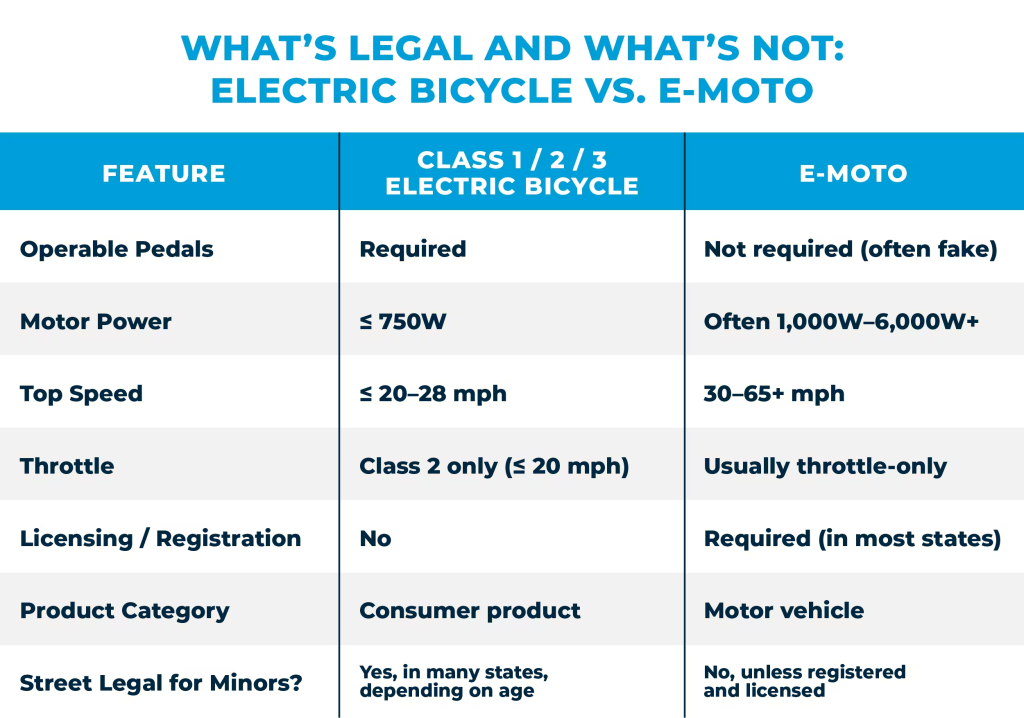
Under federal law, e-motos are classified as actual motor vehicles that are subject to the National Highway Traffic Safety Administration regulations. Because e-motos and e-bikes are classified differently in Federal statutes, they are not supposed to be treated or regulated the same way.
Yet e-motos are sold online or in stores, frequently marketed deceptively as “e-bikes”, even though functionally, they’re actually not e-bikes at all.


Worse still, some e-moto manufacturers, including Juiced Bikes, Onyx, Sondors, and others, exploit a legal loophole by adding a “Class 2 mode” that artificially limits the top speed to 20 mph, or by adding stationary pedals, making their vehicles casually look like a real e-bike, so they can deceptively market them as “street-legal e-bikes” on social media and via resellers.
It’s certain that a number of adults have purchased e-motos for themselves, usually with full knowledge and appreciation of what they actually are and how and where to properly ride them.

But, many of these e-motos are being purchased either by teenagers, or FOR teenagers by parents who haven‘t done their homework and may not know that these e-motos aren’t actually e-bikes, don’t know how powerful they are, and don’t know that they can be modified.

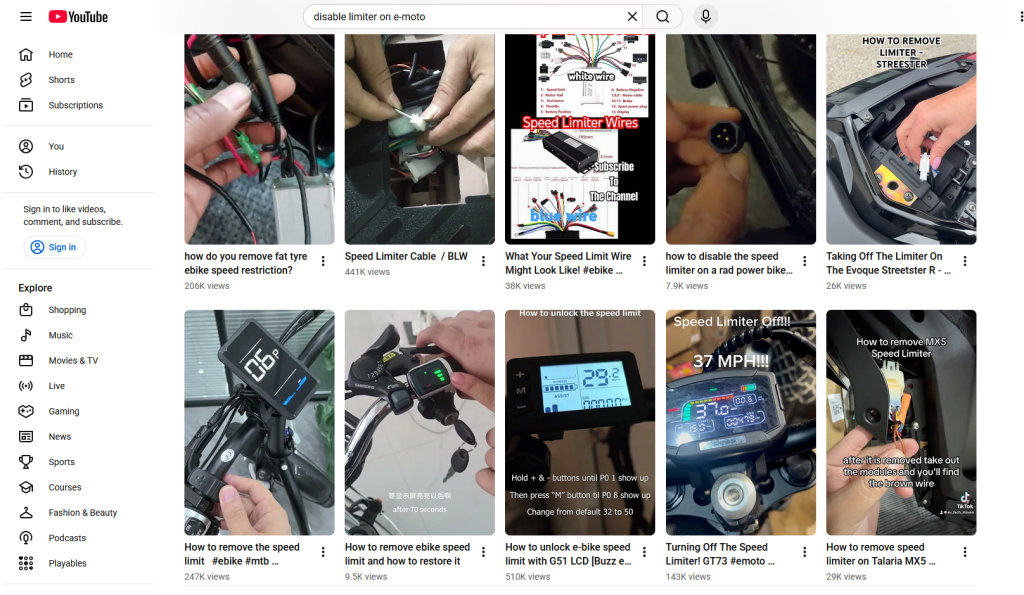
The fact is that if an e-moto is equipped with a speed limiter, this system can be disabled by a magnet, a series of keystrokes, or a simple YouTube tutorial – hacks that are rarely put on paper by the manufacturers, but ARE very frequently shared by owners on social media.
And this exposes the big problem with e-motos.
The Problem Isn’t E-Bikes—It’s Misclassification & Bad Data

When people see someone flying down a trail at 35 mph on something that casually looks like an e-bike, they don’t say:
“Wow, that’s an illegally operated electric motorcycle.”
They say:
“E-bikes are dangerous!”
But this is wholly inaccurate, because no study has actually proven that.
Now, I’m a medical provider and I know how to read research studies. And I’ve seen the studies that some of these jurisdictions, including New Jersey, appear to be using to justify their claim that “all electric-powered two-wheelers are dangerous” and require restrictions.
The Studies
When the subject of “e-bike injuries” arises, four studies are frequently cited. They are:
- Fernandez AM, Li KD, Patel HV, Allen IE, Ghaffar U, Hakam N, Breyer BN. Electric Bicycle Injuries and Hospitalizations. JAMA Surg. 2024 May 1;159(5):586-588
- Burford KG, Itzkowitz NG, Rundle AG, DiMaggio C, Mooney SJ. The Burden of Injuries Associated With E-Bikes, Powered Scooters, Hoverboards, and Bicycles in the United States: 2019‒2022. Am J Public Health. 2024 Dec;114(12):1365-1374.
- DiMaggio CJ, Bukur M, Wall SP, Frangos SG, Wen AY. Injuries associated with electric-powered bikes and scooters: analysis of US consumer product data. Inj Prev. 2020 Dec;26(6):524-528.
- Younes H. Comparing injuries from e-scooters, e-bikes, and bicycles in the United States. J Cycling Micromob Res. 2025 Jun;100061:2950-1059.
However, this research, while well-intended, all falter with the same consistent problem.
The Problem With The Current Research
All of the studies specifically exclude e-motos in their findings. Instead, all of them report relying on datasets from the National Electronic Injury Surveillance System (NEISS), managed by the Consumer Product Safety Commission (CPSC).
But as currently written, the codes are somewhat ambiguous, appearing to misclassify e-bikes, seemingly lumping them in the same coding category as e-motos and powered scooters. While technically, the NEISS code seems clear – code 5045 is an electric bike – the issue is this:
Who is deciding that it was an electric bike involved in the injury?
This creates confusion for emergency department personnel when trying to decide which NEISS code under which to report an injury. More on that in a minute.


Regarding the current research, the most seemingly egregiously-error-filled study was Fernandez, who cites using NEISS codes 5035 (Minibikes, powered), and 3215 (Household appliances) and specifies excluding injuries from motor bikes and minibikes. Even though Fernandez cites code 3215, it doesn’t appear that the data reported actually includes “household appliances.”
Burford and DiMaggio appear to be committing the same errors as Fernandez, by relying on emergency department reports of injury through NEISS codes alone, not cross-referencing reports through other methods (police reports, chart records, etc.). This type of cross-referencing would be incredibly time-consuming, but it would result in potentially clearer data.
Younes appears to do the same thing; but in my view she seems to be a bit narcissistic because the text of the study cited above reveals consistent references to her own prior work instead of fresh, original research.
The Problem With Bad Data: You Get Bad Results
After berating these researchers for their flaws in their studies, I will give them one thing: if they’re relying solely on NEISS reporting, then it’s no wonder that they’ve come up with inaccurate percentages of “e-bike” injuries, because of how the injuries are coded in the first place.
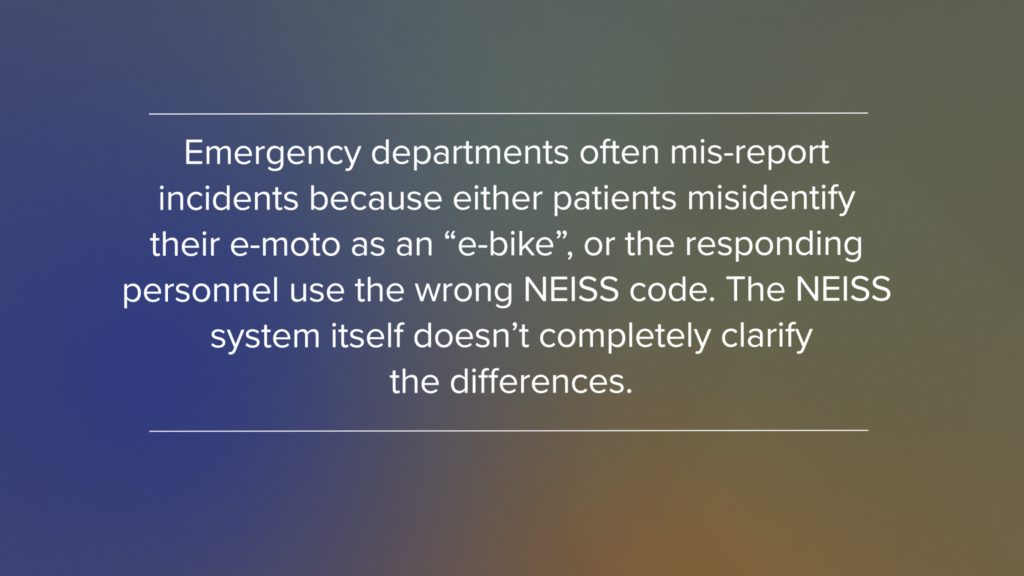
Ask any teenager who’s landed in an emergency department to tell the ED provider what he/she was on when the injury was sustained, and the answer will almost certainly be “I was riding my E-BIKE” – even if the patient’s “e-bike” was actually an e-moto.
Thus, injuries on e-motos will almost certainly get misclassified by ED providers as occurring as a result of an “e-bike” (NEISS codes 5045 or 5036), and not an e-moto.
This is the central focus of the problem with the current research, and why it is wrong for legislators to rely on such inaccurate research as a nexus for regulatory decision-making.
The Seemingly Impossible Task
It is absolutely impossible to obtain accurate injury data regarding e-bikes currently, because:
- The NEISS codes are not clear enough to unerringly distinguish between an e-bike, an e-moto, and an electric scooter; and
- Emergency department staff are unlikely to probe deeper than an “I was on my e-bike” response from a patient in order to determine precisely what type of powered “bike” the injured person is describing.
For these reasons, huge errors will persist in determining injury data on e-bikes and e-motos until the problems are resolved.
So What Do We Do?
Two things need to happen, then.
First, the CPSC needs to update the language and codes in the NEISS manual to clearly distinguish a class 1, 2, or 3 e-bike (the only actual e-bikes) from e-motos, powered scooters, and other micromobility devices.
Second, emergency departments across the country – from the providers (physicians, nurse practitioners, and physician assistants) to the nurses, aides, and intake staff – need to be re-trained to ask the right questions, and not take “I was on my e-bike” for a legitimate answer; especially if the injured person isn’t an adult.
Garbage In, Garbage Out
So instead of fixing the issues with injury reporting, enforcing existing Federal definitions, or cracking down on misrepresented vehicles, their manufacturers, and their riders who likely aren’t trained to properly ride what is actually an electric motorcycle, some jurisdictions are going about this the wrong way.
They’re proposing so-called “solutions” that actually serve to punish every e-bike cyclist across the board by erroneously lumping them and their e-bikes in the same category as e-motos and their riders, and relying on incomplete and inaccurate injury data to justify their push for e-bike restrictions.
Why Licensing & Insurance Are a Bad Fit
Creating local or state laws based on this misclassification of what is and is not an e-bike, is frankly, a horrible attempt to apply a “one-size-fits-all” bandage on the issue, while these legislators ignore what they should be doing. States and the Federal government should be holding accountable the various e-moto manufacturers who are deliberately exploiting lax governmental enforcement of e-motos, and very often minimizing the dangers of these motor vehicles in the wrong or untrained hands – especially teenagers.
Forcing e-bikes into a “motor-vehicle” classification causes real harm in a number of ways.
1. It Creates a Barrier to Entry
Requiring licensing, registration, and insurance of low-power e-bikes would add significant cost and would increase bureaucratic barriers for e-cyclists. It’s exactly the opposite of what we should want for safe, sustainable transportation.
Such regulations wouldn’t actually make e-motos less accessible or less dangerous in the wrong hands. They’d have an unintended consequence of making actual e-bikes less affordable and less attractive to e-bike users who see an e-bike as a tool for their health and their daily lives, not as a toy to race like e-motos are often used for.
2. It Discourages Active Transportation
E-bikes reduce car trips, congestion, vehicle emissions and deadly pollution, as well as parking demand. They are a fantastic “green” transportation option.

Making e-bikes harder to own and use, pushes people back into cars. Not only would this negatively impact the overall public health, it would also increase motor vehicle traffic and potential traffic accidents, as well as increase fossil-fuel energy use leading to increased emissions and pollution, resulting in further negative impacts on public health and the climate.
3. It Breaks Trail Access
Most multi-use trails are designed for bicycles, not motor vehicles.
But if a jurisdiction re-classifies e-bikes as motor vehicles, then trail managers in those jurisdictions may have no choice but to ban them outright, even where they’re causing NO real safety issues at all.
Despite the fact that the aforementioned studies on so-called “e-bike injuries” are using badly-coded datasets, the wider body of evidence – including police and news reports – appears to show that improper use of e-motos are causing more traumatic injuries and deaths than responsible adults riding e-bikes.
A Personal Observation
I can personally attest to improper e-moto use, because I’ve actually seen some young e-moto riders over the years, weaving in and out of local town traffic, racing, and even illegally riding their e-motos on rail-trails when they think they can get away with it – and many of them weren’t wearing any head protection, which itself compounds the danger of a high-powered e-moto.
Now, I personally believe that every bicyclist, e-moto rider, or gas-powered motorcycle rider should be using helmets. I’m also personally opposed to the “no helmet required” motorcycle laws in several states including my own (but that’s another story).
If such laws re-classifying e-bikes as motor vehicles were allowed to be enacted in various jurisdictions, or across the country, then potentially millions of e-cyclists would find themselves being banned from multi-use trails, which are among the safest places for us to ride.
4. It Solves the Wrong Problem
Let’s be clear here: while the original intention of such legislation may be honorable – an effort to reduce injury and death – the riders causing concern are not usually on legally-defined e-bikes. They’re on e-motos, which some manufacturers and riders erroneously claim are “e-bikes”.

Now, I don’t want to sound like I’m getting “down” on young people here. But as mentioned earlier, much real-world evidence points to a high number of injuries that emergency departments misclassify as being related to an “e-bike”, are actually occurring on e-motos, and by people under 25. While many of these young people may know how to ride a standard bicycle, it’s very likely that they’ve received little or no training on how to ride a motorcycle – electric or otherwise – which is not the same as riding a bike.
So, creating “one size fits all” legislation that unjustifiably lumps e-bikes in the same category as motor vehicles, doesn’t only ignore the actual Federal definitions of the products or real-world evidence of injuries, it solves the wrong problem.
Such legislation wouldn’t necessarily stop illegal e-moto use – it would effectively criminalize actual cyclists.
And it wouldn’t solve the real problem of how to reduce injuries and deaths on and by e-motos, which should be the real focus here.
Why Cyclists & Advocates Are Pushing Back
Groups like People For Bikes, The New Jersey Bike & Walk Coalition, the Bicycle Coalition of Greater Philadelphia, and many other cycling and trail advocacy organizations, oppose such legislation because we all understand what’s really at stake here.
This isn’t just about New Jersey.
If one state successfully reclassifies all e-bikes as motor vehicles, others may follow – and decades of progress in bicycle access, trail development, and mobility equity could unravel.
A Better Path Forward
Now let’s face it. The e-moto problem exists at least partially because of regulatory gaps and inconsistent enforcement at all governmental levels.
Advocacy organizations have been calling for comprehensive federal action for a long time.
The first place to start, is right at the top with the Federal government.
The NHTSA standards are already there. E-motos definitely fall into the category of legal motor vehicles, subject to federal motor vehicle safety standards, regardless of the attempts by some e-moto manufacturers to label their products as “off-road use only” so they can sneak around compliance regulations. We know that many e-moto users ride on public roads, because the research shows that a high number of e-moto injuries occur there.
So as cyclists, we need to demand the following actions:
Enforce Existing Regulations
The NHTSA needs some teeth. They need explicit authority and resources to be able to enforce the regulations already in place, and require states and local jurisdictions to enforce proper use of e-motos, including proper training and mandatory helmet use, by every e-moto rider, including teenagers.
Close the “Off-Road-Use” Loophole
The Federal government also needs to eliminate the “off-road-use” loophole that in my opinion, some of these e-moto manufacturers are deceptively using to market their products to people who have a higher risk of injury or death from improper use.
Truth In Advertising
The Federal Trade Commission already has a “truth in advertising” law, but it is rarely enforced with respect to e-motos. So, the Federal government needs to strictly enforce truthful advertising on the part of e-moto manufacturers and resellers. They need to require that manufacturers clearly disclose to customers that their products are not e-bikes because they don’t fit the Federal definition of an electric bicycle.
Customers need to be fully informed that the e-moto they may be intending to buy for themselves or their children, are not bicycles, but instead are motor vehicles that would require a license, registration, and insurance based on state laws.
Federal regulations need to be enforced that explicitly prohibit any false advertising of motor vehicles as “e-bikes”, and they need to enforce penalties for violations.
States Need To Step Up – The Right Way
Until the Federal government comes up with these concrete actions, states need to step up to the plate and coordinate with each other, to fully recognize and enforce in their state statutes, the existing Federal definitions and differences between an e-bike and an e-moto. States should not try to rewrite the Federal laws.
States: Follow Existing Federal Definitions and Regulations
States need to universally acknowledge what the Federal government already says: that e-bikes are low power electric bicycles and not motor vehicles, and thus are not subject to the same licensing and restrictions as motor vehicles in their states.
States: Enforce Licensing Requirements for E-MOTOS, Not E-Bikes
States need to enforce licensing, registration, insurance, and age-limit requirements for e-moto use in their states, reflecting the Federal statutes defining e-motos as motor vehicles. They need to start including e-motos into their motor vehicle licensing process, requiring proof of license, state registration with vehicle identification numbers, and proof of motorcycle-type insurance before the purchase can be completed.
States: Enforce E-Moto Regulations & Safety at the Local Level
States need to push their local municipal governments and police forces to actively enforce compliance with motor vehicle laws by e-moto owners and riders, in an effort to increase traffic safety and reduce injury and death from improper or illegal e-moto use.
Achieving Safety… the RIGHT Way
Everyone – including the Federal, state, and local governments, police forces, the medical community, cyclists (no matter what we’re riding), e-moto users – yes, everyone, needs to work together to achieve the following:
- Enforce existing e-bike class definitions
- Crack down on mislabeled electric motorcycles
- Educating retailers and consumers
- Regulating bicycles and motor vehicles not out of fear or political grift, but based on standard definitions of speed, weight, and design
Working Together
When we work together to do this, we can not only protect legitimate e-bike users, but also make e-moto use safer.
This shouldn’t be about punishing cyclists on e-bikes, or even vilifying e-moto riders. It’s about following established definitions and laws, to make everyone safer on our roads and trails.
E-Bikes Aren’t The Enemy
E-bikes aren’t the enemy of cycling—they’re one of its strongest allies.
They get more people riding, more often, and for longer distances. They make trails more inclusive. They replace excessive motor vehicle use. And they keep cycling relevant in a changing world.
Laws based on misunderstanding don’t improve safety — they just create new problems.
Here’s Your Wake-Up Call
Education is paramount here. So, if you care about trails, cycling access, or active transportation, now is the time to pay attention — and speak up.
Speak Up
If you’re in New Jersey or any jurisdiction proposing these “one-size-fits-all” laws, I encourage you to contact your government officials and let them know that you oppose any law or ordinance that mis-classifies e-bikes as “motor vehicles.”
Speak Out
Educate others about this topic. Visit the websites for various bicycle and trail advocacy organizations (click on their names above to link to their websites) for more information, and share this information with others. Knowledge is power and can really make a difference here!
Just Get Out There and Ride
At Secrets of the Trails, one of my goals is to educate everyone on enjoyable – and safe – trail experiences, no matter what you’re riding. So I encourage all of you to keep bicycling, hiking, or e-moto riding – but please do it all legally, and safely!


