

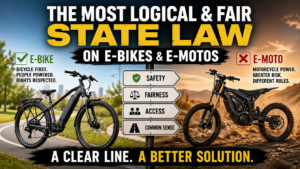
This article deals with defining the specific legal similarities and differences between e-bicycles (e-bikes) and e-motorcycles (e-motos), answering the most common questions raised about the two types of devices.
E-Bicycles (E-Bikes)
We’ll start by clearing up one of the most common misconceptions.
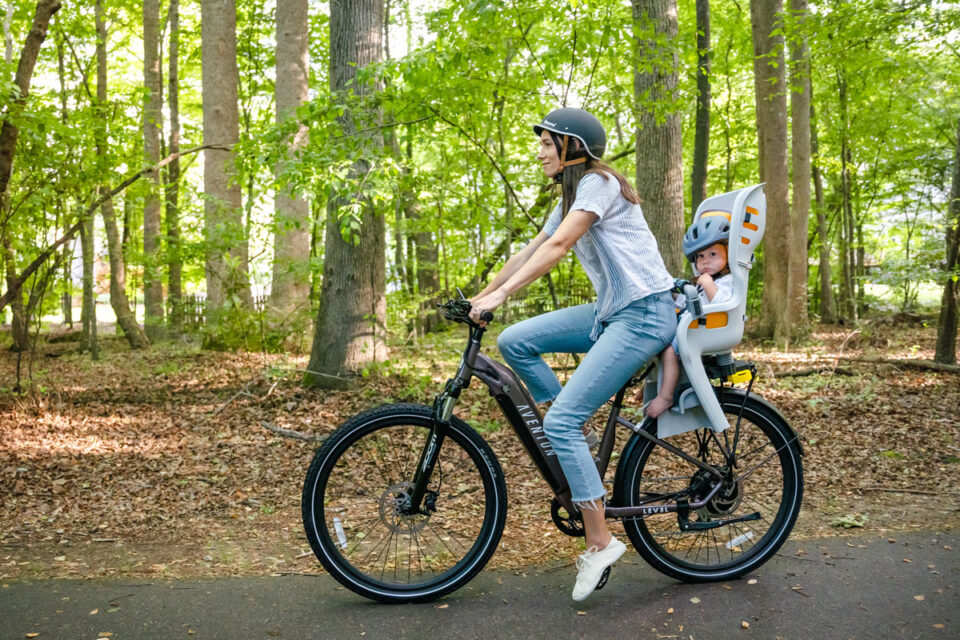
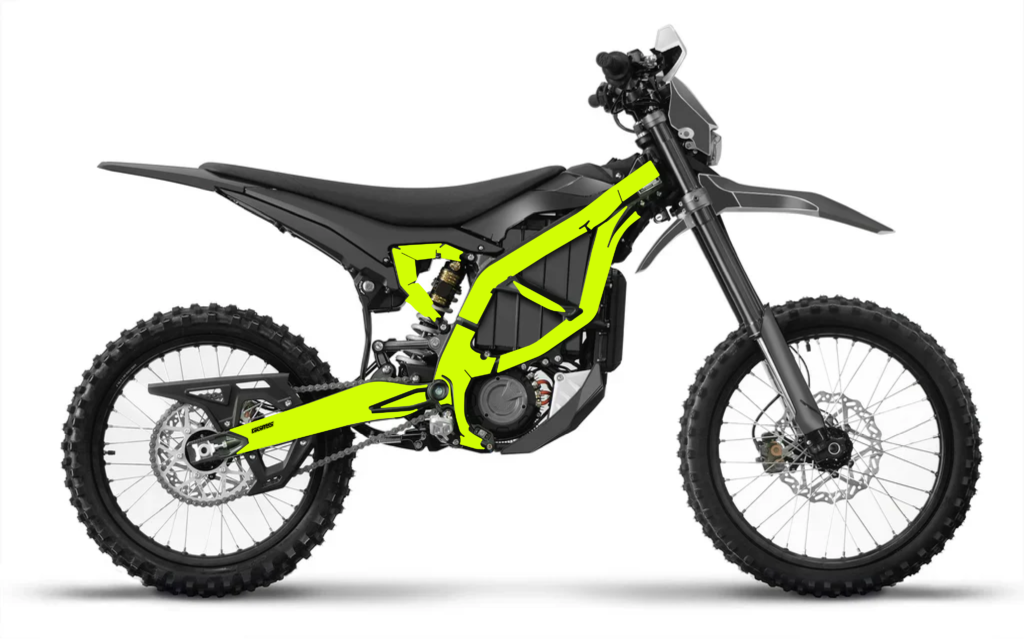
An e-bike and an e-moto are absolutely NOT the same thing.
What Is An E-Bike?
The Consumer Product Safety Act (CPSA) (15 U.S.C. § 2085) is a Federal law enacted in 2002, overseeing consumer products.
It defines e-bicycles, or “e-bikes” as low-powered electric bicycles, and includes descriptions of the classifications that qualify for the legal definition of electric bicycle and thus, consumer product.
In the U.S. and several other countries, a three-class system defining e-bikes has long been established, delineating the various types of “true” e-bikes.

- Class One is pedal-assist only, with a maximum motor-assisted speed of 20 miles per hour.
- Class Two is a pedal or throttle-assist, with a maximum motor-assisted speed of 20 miles per hour. The throttles are mostly thumb-actuated throttles.
- Class Three is a pedal-assist, with a maximum motor-assisted speed of 28 miles per hour.
Why Does the CPSA Say “Less than 750 Watts” and “20 mph”?
The Consumer Product Safety Act as currently written, slightly differs from the real-world three-class e-bike definitions, listing the following as definitions for e-bikes:
(b) Definition
For the purpose of this section, the term “low-speed electric bicycle” means a two- or three-wheeled vehicle with fully operable pedals and an electric motor of less than 750 watts (1 h.p.), whose maximum speed on a paved level surface, when powered solely by such a motor while ridden by an operator who weighs 170 pounds, is less than 20 mph.
E-bike critics love to point out the words “less than” in the definition, but completely ignore the rest of the sentence; including the “1 h.p.” parenthetical, the “powered solely by such a motor”, and the “operator who weighs 170 pounds.”
But their arguments fail to understand the reality of the circumstances that existed when the law was created in 2002.
The math
Let’s consider the math: 750 watts is equivalent to 1.01 horsepower (mechanical horsepower is typical in the U.S.). One horsepower is actually equivalent to 745.7 horsepower.
Since both numbers are listed in the law, it’s clear that Congress included horsepower as a familiar benchmark, with the 750 watt number as a rounded expression of “about 1 horsepower”. Congress was using a rating equivalence, not requiring lab measurement of fluctuating electrical input or output.
It’s also clear that Congress meant a motor’s rated power (nominal/continuous output), not moment-to-moment measured output, when it wrote 15 U.S.C. § 2085.
Considering the capabilities of electric bicycles that existed when the law was enacted, it becomes clear that the 20 mph cap and 170 lb test rider in the same statute points to “design-based” thinking that went into the law, not a “hyper-literal” knife-edge distinction between 749 and 750.
This is why states who have already enacted their own laws, list e-bikes as being defined as 750 watts or under.
Timing is everything
Consider also that in 2002, the vast majority of e-bikes in manufacture were lower than 750 watts to begin with; a few experimental brands with motors greater than 750 watts existed back then. E-bikes were less common in 2002 than they are today, which is why the 3-class system was developed in the first place, to account for all true e-bikes with motors less than or equal to 750 watts.
Product classification from the start
The statute is a consumer product classification law. It defines what qualifies as a low-speed electric bicycle.
Classifications like this are usually based on design characteristics that can be identified consistently, such as fully operable pedals, motor rating and top speed capability. These are product specifications.
If Congress meant “instantaneous measured output”, classification would become unstable.
A bike could be legal at one moment under light load, then illegal when climbing a hill, then legal again when coasting.
That would be completely unworkable.
Manufacturers need a compliance standard
A manufacturer has to know before sale whether a product falls inside the category. That only works if compliance attaches to something determinable in advance, like nameplate rating, certified continuous power rating, and design-limited controller settings – not whatever a dynamometer shows under some later test.
The speed part of the law works the same way
The “under 20 mph” piece is based on capability under a specified test condition, not random real-world momentary bursts. Besides, very few cyclists weigh exactly 170 pounds. Some are lighter, others are heavier. And, as I’ve mentioned multiple times, any bicycle – motor-assisted or not – can very easily exceed 20 mph, just by the cyclist pedaling harder and/or going downhill.
Beyond this, the fact that e-bike motors are designed to stop producing assistance when a 20 mph speed (classes 1 and 2) is achieved, all point to the clear fact that the 20 mph designation is not meant to be a case of “the rider can never be allowed to exceed 20 mph”, but rather it’s a design characteristic for compliance standardization.
The logical conclusion
So, although e-bike critics would say:
“The law means the motor can never produce 750.000 watts or more at any instant,”
That interpretation would make the statute impossible to apply, since electric motor output fluctuates continuously.
The logical conclusion of Congress’ statute is:
Congress meant the motor’s rated power (commonly understood as nominal or continuous power), just as the speed limit is based on rated capability under specified conditions.
That is a much stronger argument than trying to fight over whether “750W” secretly means 749.
What Do All E-Bikes Have In Common?
All true e-bikes:
- have fully operable pedals,
- require human power,
- have electric motors no greater than seven hundred fifty watts (750W),
- have a motor system that assists but does not replace pedaling,
- have a motor system that stops providing assistance when a set speed (20 or 28 mph) is achieved.
E-bikes weigh roughly the same as a touring bike with panniers, move at speeds similar what a non-e-bike cyclist can achieve, and are already governed by existing traffic and trail rules.
Do E-Bikes Require Licensing and Registration?
Technically not. Because true e-bikes are classified in Federal law as consumer products, not motor vehicles, e-bikes are not subject to vehicle code regulations such as vehicle registration, operator licensing, and insurance coverage.
There have been bills introduced in states and municipalities, intending to reclassify true e-bikes as “motor vehicles” thus requiring them to be state-registered and requiring the rider to have a license and insurance coverage like gas-powered motorcycles. So far (as of the date of this article) only New Jersey has done this.
But the problem with such restrictions is that they technically violate the Consumer Product Safety Act that regulates e-bicycles, and such state laws can certainly be legitimately challenged in court.
Why Can E-Bikes Exceed Their Maximum Speed?
Actually, any bicycle – motor-assisted or not – can easily exceed 20 or 28 mph.
How it does this is simple: the rider pedals faster, producing more speed.
As noted above, all true e-bikes are designed to provide motor assistance up to a set speed limit. Once that speed is achieved, the motor stops providing assistance until the speed drops back down below the set limit.
Non-powered bicycles can easily achieve well over the typical 15 mph speed limit posted on many multi-use trails, when the cyclist pedals with enough force to propel the bicycle beyond 15 mph, including the maximum motor-assisted speed cutoffs (20 or 28 mph) of e-bicycles.
Therefore, any speeds that an e-bicycle can achieve beyond the motor cutoff limit, is purely the effort of the cyclist, not the motor. As such, any state or local regulations targeting e-bikes due to the speed that they can achieve, is pointless, because even a non-powered bicycle can easily achieve the exactly the same speeds.
So, speed isn’t actually the issue. But this also brings up a very important point that applies to all cyclists, regardless of the type of bicycle they’re riding.
All cyclists, regardless of bicycle type, should be consistently adhering to trail/road rules, and practicing common courtesy and established cycling etiquette, which includes speed limits and slowing around pedestrians or other trail/road users.
E-Motorcycles (E-Motos)
What Is an E-Moto?
Another Federal law (49 CFR §571.3) is entitled Federal Motor Vehicle Safety Standards (FMVSS), which defines and regulates motor vehicles for the Department of Transportation and the National Highway Traffic Safety Administration.
This law contains two definitions that clearly classify motorcycles and e-motos as motor vehicles (not consumer products):
- Motorcycle means a motor vehicle with motive power having a seat or saddle for the use of the rider and designed to travel on not more than three wheels in contact with the ground.
- Motor-driven cycle means a motorcycle with a motor that produces 5-brake horsepower or less.
To clarify, “5 brake horsepower” is approximately equal to a 3,700 watts. A 750-watt motor (the highest e-bike rating) is just less than 1 horsepower.
But Isn’t The Law Pretty Vague?
I occasionally hear this question used in reference to the FMVSS. However, it can only be called “vague” when taken in a vacuum.
But Federal laws don’t exist in a vacuum. In this case, the FMVSS and CPSA don’t contradict each other, they compliment each other.
It is true that as of the date of this article, there is no separate Federal category for “high-powered e-bike” in the FMVSS. Some e-moto enthusiasts will point to this as reason why their e-motos should not be required to be registered and licensed like motor vehicles, and that they should be allowed to ride their high-powered e-motos wherever and however they want, without governmental regulation or interference.
But this “vagueness” argument falls apart when we realize that the rather broad-brush nature of the FMVSS as currently enacted, is actually a favorable thing considering that the CPSA is very specific in its definitions.
So the point is clear: if a device in question falls outside the definitions of the CPSA governing low-powered electric bicycles, then it automatically falls under the FMVSS as a motor vehicle, which requires state-level vehicle registration, operator licensing, and insurance coverage in order to legally ride it in public.
What Do All E-Motos Have In Common?
With the above classifications in mind, the definition of an electric motorcycle, or “e-moto”, is very simple.
The term “e-moto” applies to any two-wheeled vehicle that exhibits two distinct differences from true e-bikes:
- All e-motos have a motor that exceeds 750 watts.
- And all e-motos have the capacity for motor-assisted speed greater than 28 mph.
That’s it. It makes no difference what brand of e-moto is in question (and there are many).
The distinctions are clear: if the device in question does not qualify as an e-bike under the 3-class system/CPSC regulations, then it is not an e-bike, it’s an e-moto. Period. There is no vagueness or “wiggle room” here.
But What If It Looks Like A Bicycle, or Has Pedals? Doesn’t That Matter?
No.
Appearance
While it is true that there are several brands of performance 2-wheelers out there that “look” like bicycles, the fact is that appearance means nothing to the established definitions and classifications.
Any two-wheeled device can be built to look like either a bicycle or a motorcycle. But from a legal standpoint, the distinction comes down to two factors: the device’s continuous motor wattage, and its top motor-assisted speed.
As one example, “Wired” is a major brand of high-powered 2-wheeled vehicle. Their vehicles all have the appearance of a true e-bicycle, however they’re manufactured with a 1,000 W or higher motor, which clearly place them outside the CPSA’s definitions.
Wired claims that their vehicles can be software-modified to “act” like a Class 1, 2, or 3 e-bike; however Federal guidelines do not legitimize software-level “down-moding”.
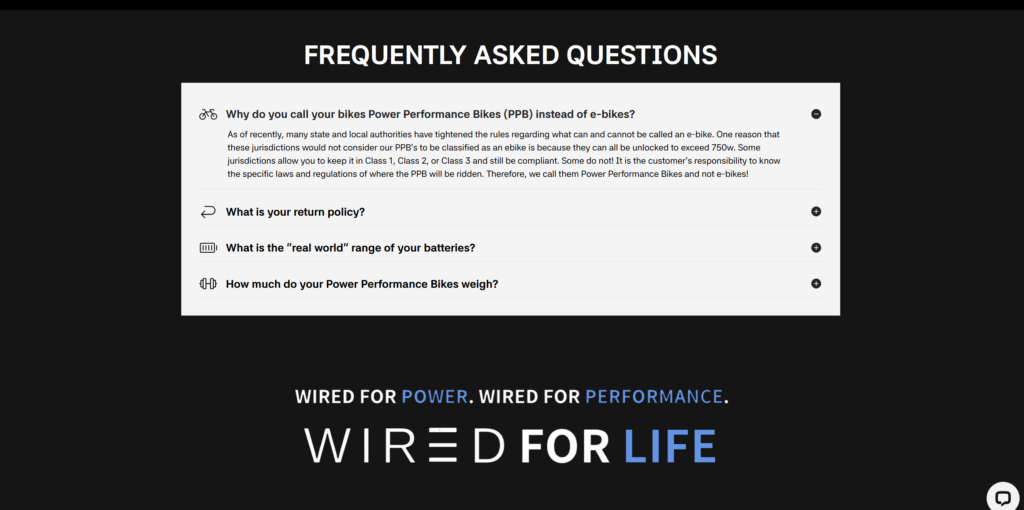
Wired even admitted this fact on their website in the FAQ section where they call their vehicles “power performance bikes” instead of “e-bikes” in a clear effort to avoid any legal scrutiny. However, a number of jurisdictions around the country have already moved to prohibit down-moded machines on trails and some streets, effectively making “down-moding” illegal.
Pedals
Just like appearance, the existence of pedals – even operating pedals – is not a legitimate criterion for the defining e-motos.
Mopeds in their day, also had operating pedals, but the existence of the pedals on mopeds meant nothing compared to the fact that mopeds had motor-assisted speeds that easily exceeded 28 mph (mopeds have largely been replaced in recent years by electric scooters, sometimes called “nopeds”, which are also classified as motor vehicles). Because of this, mopeds have always been classified as motor vehicles, not bicycles.
The bottom line on this question is this: appearance and pedals mean absolutely nothing to the legal definition of a device.
When attempting to define a device as either an e-bike or an e-moto:
Motor wattage and motor-assisted speed are the only two things that matter.
Put simply: if a device has a motor exceeding 750 W continuous rating (peak wattage doesn’t matter to the Federal regulations), or can exceed 28 mph in motor-assisted speed, it’s is not an e-bike, it is an e-moto.
Do E-Motos Require Licensing and Registration?
Absolutely yes, because they are legally motor vehicles according to Federal law.
However, Federal law makes no provision for a nationwide registration system or insurance coverage on e-motos. The reason why is simple: the U.S. government does not issue “national” driver licenses or engage in vehicle registration. That power is granted to the states.
All that the U.S. government says through its laws, is that a certain device is classified either as a consumer product or as a motor vehicle. The states are then responsible to use their legislative authority to issue their own driver licenses and engage in the registration of vehicles within their borders for e-motos, dirt bikes, and other devices Federally classified as motor vehicles.
So, when a particular state moves to add e-motos to their vehicle codes, they will then require e-moto registration, rider licensing, and insurance coverage within that state.
But keep in mind that not every state has done this yet. More populous states, like California and New Jersey, already have. Eventually however, this will become more common, as more states realize that they need to follow Federal regulations and guidelines concerning e-motos.
Regulations Pertaining To Both E-Bikes and E-Motos
Do E-Bikes and E-Motos Have To Follow Traffic Rules?
Yes! In nearly every jurisdiction in the country, when cyclists and e-moto riders use public roads, they are all expected to follow established standard traffic rules, including:
- stopping at stop signs
- obeying traffic signals
- yielding to pedestrians and at posted intersections
- signaling their intentions to turn
- not exceeding posted speed limits
These traffic rules apply equally to e-bikes and e-motos.
A few states in the country have adopted versions of the “Idaho Stop“, a law first enacted in Idaho in 1982 that allows bicyclists to treat stop signs as yields, and red lights as stop signs. While I personally disagree with this concept particularly in certain circumstances (busy intersections are a perfect example), proponents of the “Idaho Stop” concept point to a few studies purporting to demonstrate decreases in bicyclist injuries where the “Idaho Stop” laws are employed.
However, such laws only apply to bicyclists. They do not apply to e-motos because e-motos are motor vehicles, required to follow all traffic rules that apply to every other motor vehicle.
What About Off-Road Trails?

Across the country, many multi-use trails have speed limits for bicycles – standard and e-bike. They’re usually posted either along the trail itself, or on the trail’s website or on the trail map/brochure. Most multi-use trails have a 15 mph limit, while some others post a 20 mph limit. But when no speed limit is listed or posted, it is widely understood among cyclists that they should not exceed 15 mph.
“Dirt Bike” and “mountain bike” trails are sometimes a different story. These trails are not considered “multi-use” because they usually cater to e-motos and gas-powered dirt bikes, while mountain-biking trails are built such that pedestrians/hikers would find it difficult to traverse them. Often no speed limit is assigned to such trails simply because of the much higher speeds that can be attained by electric and gas-powered motorcycles. Mountain bikers are frequently changing speeds rather rapidly from relatively slow to very fast speeds depending on the conditions of the trail.
Where Can E-Bikes and E-Motos Be Ridden?
This can also be a somewhat complex question to answer, because of recent legislative changes in local and state governments.
If one considers strictly the Federal laws and classifications, then technically e-bikes can be ridden anywhere a traditional (non-power-assisted) bicycle can be used.
By that same Federal law consideration, e-motos are more restricted; they would not be permitted anywhere that posts “no motor vehicles” (such as multi-use trails, some national parks, etc.), but would be permitted on some public roads and off-road trails specifically built for e-motos and dirt bikes.
Areas Managed By State or Local Governments
However, many municipalities around the country are placing their own restrictions on e-moto and e-bike use, causing not only much confusion, but much anger among the populations that use these two different types of devices.
While the Federal laws set definitions and classifications, state and local governments can set restrictions as to the types of devices permitted in their areas of responsibility, specifically state and local parks.
For example, they can restrict certain classes of e-bikes from certain local public roads or community parks, but they can’t prohibit e-bikes from being used at all within their states or municipalities.
Areas Managed By Non-Governmental Entities
Owners/managers of local non-governmental trails (such as the Great Allegheny Passage in Maryland & Pennsylvania), are free to set restrictions on the properties that they oversee.
So, while a Class 1, Class 2, or Class 3 e-bike is still legally a bicycle, certain classes may be limited in where they are permitted to be used.
It makes sense that motor vehicles such as e-motos would be prohibited from using multi-use trails that pedestrians also use. Consider this: since a Harley wouldn’t be allowed on the Great Allegheny Passage, a Surron e-moto isn’t allowed, either. This is a widespread policy across the country, meant to decrease pedestrian injury risk and trail damage.
Two Big Factors Driving Restrictions
Regarding true e-bike use on various trails, two factors appear to be driving local policy decisions to restrict either all e-bikes, or certain classes of e-bikes, from multi-use trails.
The first factor is of course, the unfortunate widespread ignorance among legislators and the general public regarding what an e-bike actually is and what their capabilities are – and aren’t. Too many people are still confusing high-powered e-motos for e-bikes, though advocacy efforts continue nationwide to educate the public and our legislators, so that this confusion can finally be eliminated.
The other factor is also unfortunate: there are a number of cyclists riding not only e-bikes, but traditional bicycles, who flatly refuse to adhere to standards of cycling etiquette and respect for others on multi-use trails. When local governments and non-governmental trail managers see this shameful behavior, they’re much more likely to enact rules prohibiting either all e-bikes or certain e-bike classes. This is not only discriminatory (since they often won’t place those same restrictions on the “Lycra-clad youngsters” speeding on trails), it’s also a perfect example of a few “bad apples” spoiling it for everyone.
We’ll look at proper cycling etiquette standards in another article.


Pingback: Why “E-Bike Injury” Research Is Wrong - Secrets of the Trails
Pingback: The Most Logical & Fair State Law: E-Bikes & E-Motos - Secrets of the Trails